Why Nigerian Banks Struggle to Lend, and What Infrastructure Can Fix
Nigerian banks want to lend, and millions of Nigerians need credit. So why does so little of it reach everyday people? Here’s what really holds bank lending back, and how the right infrastructure can close the gap.
Walk into almost any Nigerian bank and ask for a loan without a salary account, a guarantor or a property title, and you’ll probably leave disappointed. Ask the same bank whether it wants more lending customers and the answer will be yes.
That’s the strange gap at the centre of Nigerian finance. Banks have money to lend. Millions of people and small businesses need credit. Yet the two rarely meet.
It’s tempting to blame banks for being too cautious. The truth is more practical. Banks lend when they can see, verify and recover. When any of those three is missing, the loan doesn’t happen.
Problem 1: Most Nigerians don’t have collateral a bank can use
Traditional lending leans heavily on collateral. If a borrower can’t repay, the bank needs something it can recover.
The challenge is that most Nigerians don’t hold assets in a form a bank can work with. Land might be family‑owned, undocumented or tied up in disputes. Savings might sit in Ajo groups and cooperatives the bank can’t see. Small business stock moves daily and isn’t recorded anywhere formal.
People aren’t asset‑poor so much as record‑poor. The value exists. It just isn’t verified or written down in a way a lender can rely on.
Problem 2: Banks can’t see enough data to judge risk
A credit decision is only as good as the information behind it. In many countries, lenders can pull a detailed history of how someone earns, spends and repays. In Nigeria, a large share of economic activity happens in cash or through informal channels.
Without that data, banks fall back on what they can verify: salaries paid through their own accounts, government workers, large corporates. Everyone else is treated as high risk by default, and high risk means either a high interest rate or no loan at all.
Problem 3: Recovering bad loans is slow and expensive
Even when a bank lends, getting money back from a defaulting borrower can take a long time. Legal processes are slow, and recovering a physical asset is costly. So banks price that risk into every loan, which makes credit expensive for the good borrowers too.
Problem 4: Partnerships stall at the integration stage
Banks know fintechs and platforms can bring them new borrowers. The problem is connecting to them.
Every bank runs its own core banking system, often with limited or inconsistent APIs. Plugging an outside product into the bank means security reviews, testing and approvals across several teams. What should take weeks can take months.
We saw this play out recently when Klump, a Nigerian buy now, pay later startup, shut down. Its founders said slow bank integrations held the company back after it moved to connecting shoppers with lending partners. Good distribution, willing banks, and still the connection was too slow.
What infrastructure can fix
None of these problems is solved by asking banks to take more risk. They’re solved by giving banks better tools to see, verify and connect.
Turn ownership into something a lender can trust
If a person’s assets are recorded properly, with verified title documents, a lawyer’s confirmation and a clear ledger of who owns what, that ownership becomes something a lender can actually work with.
This is the idea behind AtomCredit. It connects verified ownership, starting with real estate, to participating lenders. A customer who has built a stake in a property gradually, with every payment recorded, now has something concrete to show a bank. The lender still makes its own decision on every request. It just has far better information to decide with.
Bring savings activity into view
When contributions, deposits and payments move through proper banking rails instead of cash, they leave a trail. That trail becomes data a lender can use.
Virtual accounts are one practical way to do this. VendPocket, a fintech co‑owned by AtomAfrica and Rehoboth MFB, has opened more than 62,000 virtual accounts and processed over 500,000 deposits, facilitating ₦2B+ in inflows into the bank. That’s activity that would otherwise have stayed invisible, now recorded and banked.
(The ₦2B+ figure reflects VendPocket only, not total volume across AtomAfrica‑powered infrastructure.)
Make integrations fast instead of painful
Banks don’t need to rebuild their core systems to work with new partners. They need a modern layer on top: middleware and APIs that let platforms, developers and fintechs connect quickly and securely.
That’s the work AtomAfrica does every day. We provide mobile and internet banking, middleware and APIs, virtual accounts and core banking integrations for financial institutions. Rehoboth MFB, Sulspap MFB and Weston‑Charis MFB currently run on AtomAfrica infrastructure. When a bank already has that layer in place, a new lending partner isn’t a six‑month project. It’s a connection.
Tie credit to real assets, not guesswork
When a loan is linked to recorded ownership, recovery becomes clearer and risk drops. Lower risk can mean more approvals and fairer pricing for borrowers who have been shut out until now.
The bigger picture
Nigeria doesn’t have a shortage of money or demand. It has a shortage of connections: between what people own and what lenders can see, and between banks and the platforms that could bring them customers.
Fix those connections and lending starts to flow. That’s why we built AtomAfrica around three linked pieces: banking, ownership and credit. Each one makes the next possible.
Are you a bank, microfinance bank or lender looking to reach new borrowers with less risk? Talk to the AtomAfrica team at atomafrica.tech.
More on Financial Infrastructure & Policy
Financial Infrastructure & Policy Virtual Accounts Explained: How Nigerian Businesses Collect Payments at Scale
If your team spends hours matching bank alerts to customers, virtual accounts can fix that. Here’s what they are, how they work in Nigeria, and how one implementation used them to take a bank from under 100 deposits a day to a peak of 5,000.
Financial Infrastructure & Policy How Microfinance Banks Can Launch Mobile Banking Without Building From Scratch
Your customers already bank on their phones. The question is whether they’re doing it with you. Here’s how microfinance banks in Nigeria can get a proper mobile banking app live without spending years and a fortune building it themselves.
 Financial Infrastructure & Policy
How Ownership Becomes Credit in Nigeria: The 2026 Guide to AtomCredit
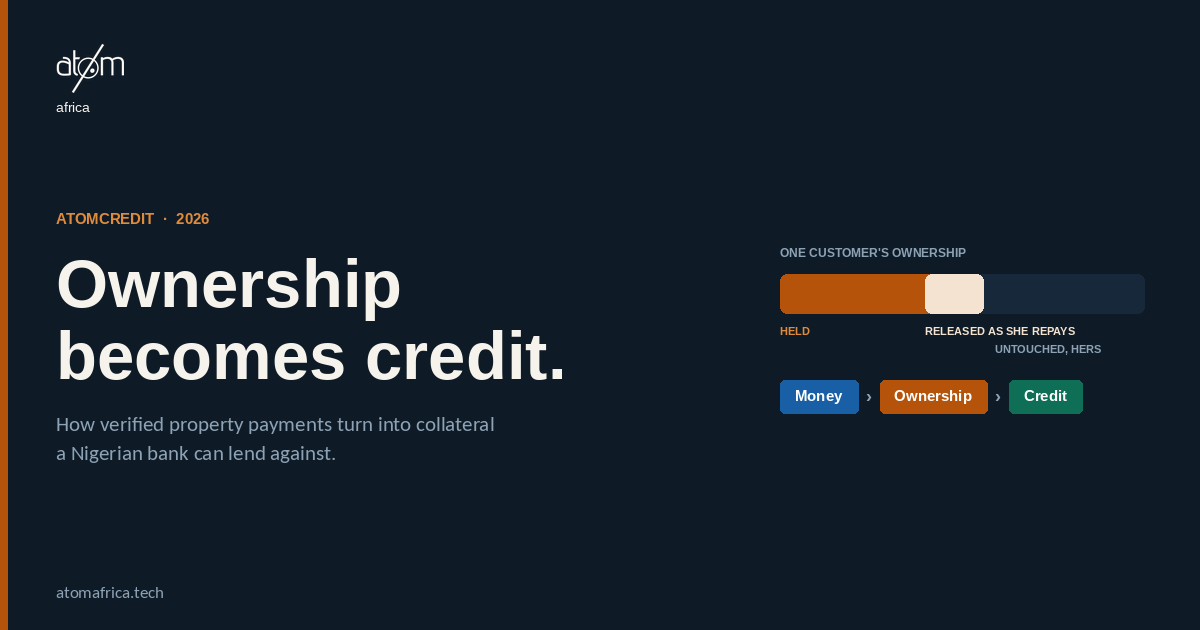
Millions of Nigerians are paying for property in instalments, yet none of it counts when they need a loan, because no bank can verify what they own. This 2026 guide explains how AtomCredit turns recorded property ownership into collateral a bank can lend against: how a request is assessed, what is held and what is released, what the bank sees before deciding, how repayment returns ownership month by month, and exactly what happens if payments stop.