Virtual Accounts Explained: How Nigerian Businesses Collect Payments at Scale
If your team spends hours matching bank alerts to customers, virtual accounts can fix that. Here’s what they are, how they work in Nigeria, and how one implementation used them to take a bank from under 100 deposits a day to a peak of 5,000.
Picture the accounts officer at a busy school, estate company or cooperative at the end of the month.
The bank alerts are rolling in. “Transfer from ADEBAYO O.” “Transfer from MRS F. AKINWALE.” “Transfer from KEMI BUSINESS VENTURES.” Some customers paid from their own accounts. Some paid from a spouse’s account. One paid twice. Another paid the wrong amount. And somebody always sends a screenshot on WhatsApp saying, “I’ve paid, please confirm.”
So the officer opens a spreadsheet and starts matching. Name by name, amount by amount. It takes hours. Sometimes days. And mistakes slip through, which means awkward phone calls with customers who did pay but are being chased anyway.
Nigerians love paying by bank transfer. It’s fast and everyone knows how to do it. The problem has never been paying. It’s knowing who paid for what.
That’s the problem virtual accounts solve.
So what is a virtual account?
A virtual account is a real Nigerian account number that’s linked to one specific customer, purpose or transaction, instead of to your main business account.
Your customer transfers money to it the same way they’d pay any other account, from any bank app. But behind the scenes, the money lands in your business account, and the system already knows exactly who sent it and what it’s for, because that account number belongs to that customer alone.
No guessing from the sender’s name. No matching by hand.
How it works, in plain terms
Say you run a real estate company with 500 instalment buyers.
Without virtual accounts, all 500 pay into one company account, and your team sorts it out afterwards.
With virtual accounts, each buyer gets their own account number. When Mrs Akinwale transfers ₦50,000 to her number, the system instantly records that Mrs Akinwale paid ₦50,000 towards her plot. Her balance updates. She gets a confirmation. Your records update. Nobody had to look at anything.
There are usually two types:
A static virtual account stays with a customer permanently. It’s ideal for anyone who pays you regularly, like instalment buyers, cooperative members or school parents.
A dynamic virtual account is created for a single payment and expires afterwards. It’s useful for one‑off invoices or checkouts.
Who should be using virtual accounts
Honestly, almost any business that collects money by transfer from lots of people. A few obvious ones:
Real estate companies with instalment buyers paying in bits over months.
Cooperatives and thrift groups collecting regular contributions from members.
Schools collecting fees from hundreds of parents.
Landlords and property managers collecting rent.
Merchants and marketplaces who want customers to pay by transfer without the confirmation back‑and‑forth.
Microfinance banks that want to win deposits by powering collections for the businesses around them.
Why it matters more than it sounds
Automatic matching saves time, obviously. But the bigger benefits are less obvious.
Customers trust you more when their payment is confirmed instantly. Fewer “I’ve paid, have you seen it?” messages means your team can do real work. Your records are clean, which matters when you’re dealing with auditors, investors or a bank. And every payment leaves a proper digital trail, which over time becomes data that can support things like credit decisions.
For banks, there’s another upside. Every business that collects through virtual accounts is moving money into the bank. More collections means more deposits.
What it looks like at real scale
VendPocket is a good example of what happens when virtual accounts work properly. It’s a fintech co‑owned by AtomAfrica and Rehoboth MFB, built to give businesses and their customers dedicated virtual accounts tied directly to the bank.
The numbers tell the story. More than 62,000 virtual accounts opened. Over 500,000 deposits processed. More than ₦2 billion in inflows facilitated into the bank. Before VendPocket, the bank was seeing under 100 deposits a day. At its peak, that number hit 5,000 a day.
That’s not a marketing campaign. That’s what happens when you remove friction from how people pay.
(These figures reflect VendPocket only, not total activity across AtomAfrica‑powered infrastructure.)
What to look for in a virtual account provider
If you’re considering virtual accounts for your business, a few questions will save you trouble later.
Which licensed bank holds the funds? You want a regulated institution behind every naira. How fast are payments confirmed? Instant confirmation is the whole point. Can it connect to your existing system or app through an API, so records update automatically? What happens when a customer pays the wrong amount or pays twice? And who do you call when something goes wrong?
Where AtomAfrica fits
AtomAfrica builds banking infrastructure for financial institutions, and virtual account services are a core part of it, along with mobile and internet banking, middleware and APIs, reconciliation tools and core banking integration. Rehoboth MFB, Sulspap MFB and Weston‑Charis MFB currently run on AtomAfrica infrastructure.
For banks, that means you can offer virtual accounts and collections to the businesses in your community and grow deposits through them. For businesses, it means a reliable way to collect from hundreds or thousands of customers without drowning in bank alerts.
And it ties into the bigger picture. On NairaPacket and AtomOwn, every ownership payment is recorded properly, which is what makes it possible to connect that ownership to credit later on.
Bank transfers aren’t going anywhere. The businesses that grow fastest will be the ones that stop matching them by hand.
Want to collect payments at scale, or offer virtual accounts to businesses as a bank? Talk to the AtomAfrica team at atomafrica.tech.
More on Financial Infrastructure & Policy
Financial Infrastructure & Policy How Microfinance Banks Can Launch Mobile Banking Without Building From Scratch
Your customers already bank on their phones. The question is whether they’re doing it with you. Here’s how microfinance banks in Nigeria can get a proper mobile banking app live without spending years and a fortune building it themselves.
Financial Infrastructure & Policy Why Nigerian Banks Struggle to Lend, and What Infrastructure Can Fix
Nigerian banks want to lend, and millions of Nigerians need credit. So why does so little of it reach everyday people? Here’s what really holds bank lending back, and how the right infrastructure can close the gap.
 Financial Infrastructure & Policy
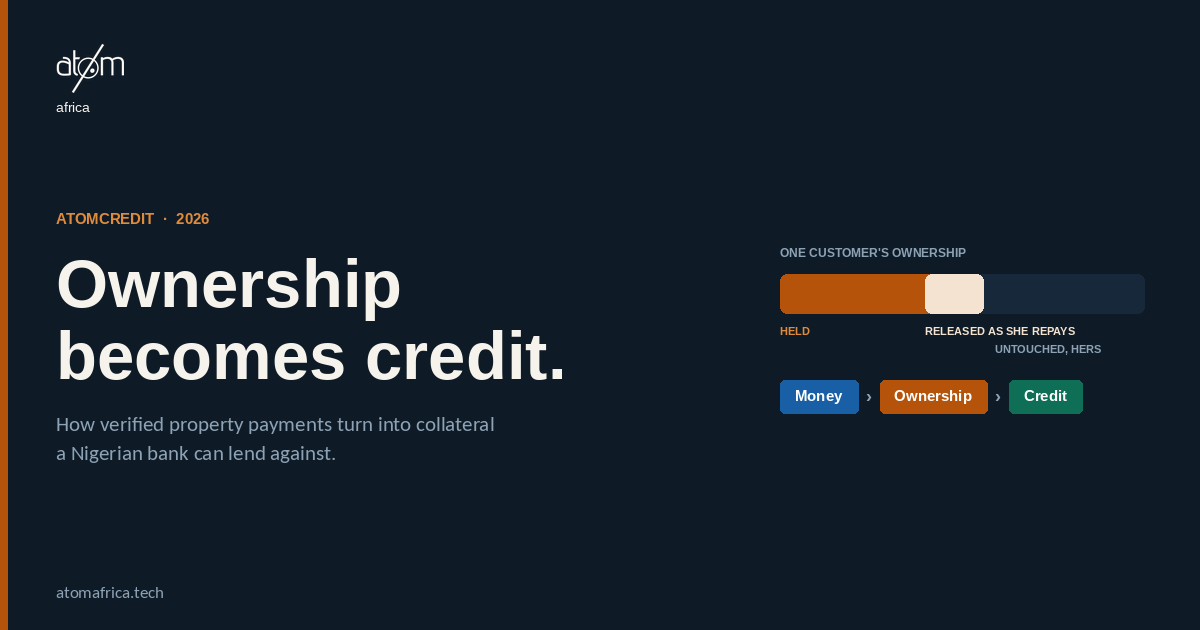
How Ownership Becomes Credit in Nigeria: The 2026 Guide to AtomCredit
Millions of Nigerians are paying for property in instalments, yet none of it counts when they need a loan, because no bank can verify what they own. This 2026 guide explains how AtomCredit turns recorded property ownership into collateral a bank can lend against: how a request is assessed, what is held and what is released, what the bank sees before deciding, how repayment returns ownership month by month, and exactly what happens if payments stop.