How Ownership Becomes Credit in Nigeria: The 2026 Guide to AtomCredit
Millions of Nigerians are paying for property in instalments, yet none of it counts when they need a loan, because no bank can verify what they own. This 2026 guide explains how AtomCredit turns recorded property ownership into collateral a bank can lend against: how a request is assessed, what is held and what is released, what the bank sees before deciding, how repayment returns ownership month by month, and exactly what happens if payments stop.
Millions of Nigerians are paying for property right now. A plot in an estate outside Ibadan, a unit in a development in Lekki, ₦50,000 at a time. Years of payments, receipts in a drawer, a WhatsApp thread with an agent.
Ask any of them what they own and they will tell you. Ask a bank, and the bank cannot answer.
That gap is the reason a customer who has paid ₦1.2M toward a plot still gets turned down for a ₦500,000 loan. Not because she is a bad borrower. Because nothing she owns can be checked.
AtomCredit exists to close that gap. Here is exactly how it works, and what it means depending on which side of it you sit.
First, what we mean by ownership
Before any of this is possible, two things have to be true.
The property has to be verified. Before a unit is listed on the network, its documents are reviewed, a qualified lawyer checks the legal position, an independent surveyor values it, and its ownership and encumbrance history is confirmed. This happens once, before anyone buys, not in a panic when a loan goes wrong.
And every payment has to be recorded as ownership. When a customer pays toward a verified unit, the payment is not just a receipt. It is recorded as a proportion of that unit, held in her name, visible to her on her phone.
That record is the raw material. Without it, there is nothing for a bank to look at.
When a customer asks for credit
She opens her account, sees what she owns, and requests an amount.
Before anything goes anywhere, the system does the arithmetic. It works out what the facility would cost in total if it ran its full course, converts that into a proportion of her unit, and checks that figure against the limits her bank has set. If her ownership is not enough to support what she is asking for, the request stops there and she is told the most she can request. It never reaches a credit officer, and her time is not wasted.
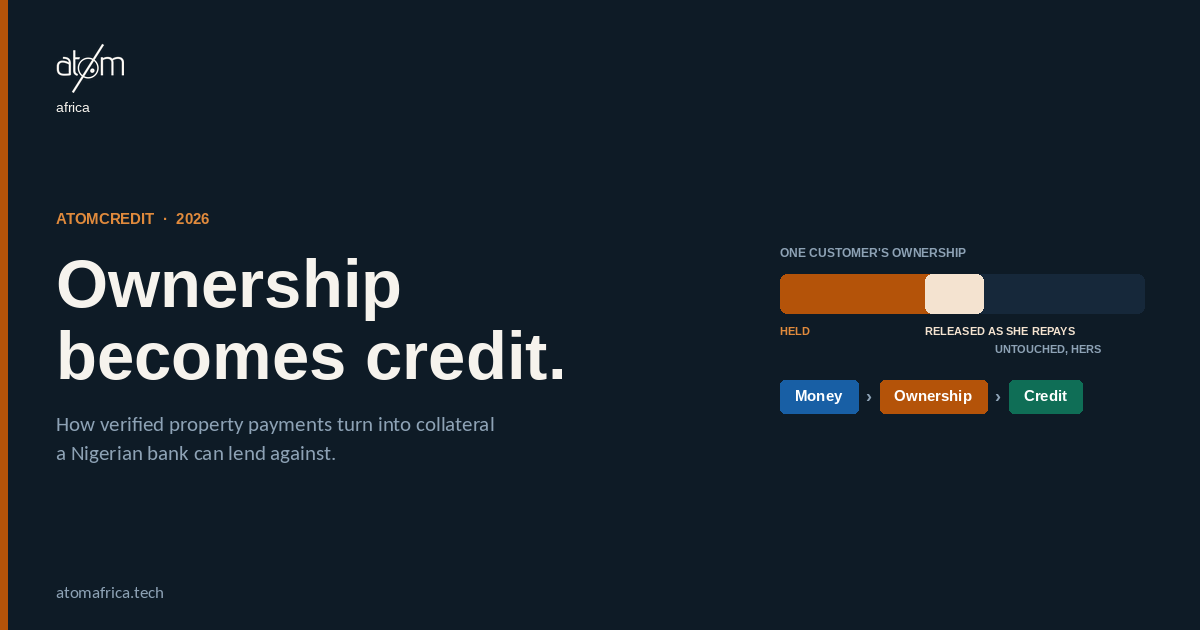
If it passes, that proportion of her ownership is held. Held, not taken. She cannot sell or transfer that part while the request is live, and neither can anyone else. The rest of her ownership is untouched and remains hers to use.
What the bank sees
With her permission, and the property business confirming the record, the bank receives a file: what she owns, every payment she has made, the verification documents, the valuation, any existing claim against the unit, and an unexecuted copy of the agreement that would secure the facility.
Then the bank decides. Eligibility, amount, rate, tenor, loan‑to‑value, all of it. AtomAfrica does not lend, does not underwrite and does not influence the outcome.
If the bank declines, the hold is released immediately and her ownership returns to normal. The request stays on the record, because a complete history is part of what makes the next request credible.
If the bank approves, the agreement is signed by all three parties, the claim is recorded against her ownership, and the bank disburses to her account.
As she repays
This is the part most people are surprised by.
Her ownership does not sit frozen until the last payment. Each time a repayment clears, the amount still at risk falls, so the held portion shrinks with it and the difference is released back to her.
Pay on time and you watch your ownership come back, month by month. It is the same money either way. It just behaves differently when it is visible.
When the facility is fully repaid, the bank issues a release, the claim comes off the record, and every remaining portion returns to her. Nothing extra is charged for the collateral having been held.
And if repayment stops
Life happens. Businesses slow, school fees arrive, people fall behind. So the honest part of this article is what happens then.
The bank is told. There is a grace period, on the bank's terms, and the customer can bring the facility back into order.
If that period passes and the facility is still in default, the held portion is sold. Not all of it. Only enough to clear what is actually owed and the cost of the sale itself. Everything beyond that is released back to the customer, and the rest of her ownership, the part that was never held, stays hers throughout.
The sale happens inside the network, to buyers who are already there looking for verified property. That matters more than it sounds. The traditional alternative is a court process and the search for a single buyer who can pay for an entire plot at once, which takes months and costs everyone money.
An illustration. A customer owns ₦10M of a verified unit. She borrows against part of it. By the time she falls behind, she has repaid a good portion of the facility. The amount still owed is what is recovered, so only the ownership needed to cover that amount and the cost of selling it is sold. The rest, both the unsold part of the held portion and everything that was never held, remains hers.
Figures used anywhere in this article are for illustration. The actual limits, rates and charges on any facility are set by the lending bank and disclosed in its offer letter.
What this means for you
If you are buying property. Your payments stop being receipts and start being provable ownership. That ownership can support a loan application, can be sold or transferred inside the network, and cannot be quietly resold underneath you. If you ever cannot continue, you keep what you have already paid for.
If you run a property business. Your buyers can be financed, which means a sale that would have stalled completes instead, and you are paid. A customer who falls behind becomes a portion that can be resold rather than a file in dispute. And every transfer on your network carries the fee you set.
If you are a bank. You get a borrower whose collateral has been verified before you ever saw it, a claim registered against a specific recorded interest, the property business's written acknowledgement of that claim, and a route to recovery that does not begin with a courtroom. Every lending decision remains yours.
What AtomAfrica is not
We are not a bank and we do not hold deposits. We do not lend, and we do not decide who gets credit. We do not sell property, and we do not guarantee any transaction. Lending is provided by licensed financial institutions under their own licences, underwriting and terms. Property and ownership records are owned and maintained by the property businesses that use the network.
What we build is the record in between, and the rails that let it move.
The point of all this
Nigerians already own an enormous amount. Property, land, half‑finished plots paid for in instalments over years. Most of it does nothing beyond sitting there, because the financial system cannot see it.
Making it visible does not create new wealth. It lets existing wealth work. A trader who can borrow against what she has already paid for can buy more stock. A property business that can sell to buyers who need financing sells more units. A bank that can verify collateral can lend to people it previously had to turn away.
Money, ownership, credit. Connected.
To talk to us about AtomCredit: hello@atomafrica.tech
More on Financial Infrastructure & Policy
 Financial Infrastructure & Policy
 Why Africa’s Financial Infrastructure Is Moving Beyond Payments
AtomAfrica is building financial infrastructure that connects banking, economic ownership and credit. With AtomOwn, NairaPacket and AtomCredit, the company is building a bridge between financial institutions, property businesses and the assets people own.
 Financial Infrastructure & Policy
 When Companies Lose Value, What Does It Say About Ownership in Nigeria?
The financial distress facing nine companies on the NGX raises a bigger question: what does ownership really mean? As Africa moves beyond simply moving money, the next opportunity is helping more people turn money into productive assets and participate in the ownership of the real economy.
 Financial Infrastructure & Policy
 Why Microfinance in Africa Needs to Go Digital
Microfinance banks are the closest thing Nigeria has to a financial system that knows its customers by name. But squeezed between fintech-shaped expectations, a regulator raising the floor, and the quiet cost of manual operations, the analog MFB is running out of decade. What real digitization looks like, and what it unlocks next.