How Microfinance Banks Can Launch Mobile Banking Without Building From Scratch
Your customers already bank on their phones. The question is whether they’re doing it with you. Here’s how microfinance banks in Nigeria can get a proper mobile banking app live without spending years and a fortune building it themselves.
Here’s a conversation we’ve had more than once with microfinance bank leaders.
They know they need a mobile app. Their customers keep asking for one. Some of their best depositors have quietly opened accounts with digital banks because it’s easier to check a balance or send money at 10pm. The MD has seen the numbers and doesn’t like them.
Then comes the hard part. Who’s going to build it? How much will it cost? How long before it’s live? And what happens if the developer disappears halfway?
So the project gets pushed to next quarter. Then the one after that.
If that sounds familiar, this piece is for you.
Why building from scratch rarely works for MFBs
Building a banking app sounds simple until you start. It’s not just screens and buttons. The app has to talk to your core banking system in real time, move money safely, handle failed transactions, pass security reviews and keep working when thousands of customers log in on salary day.
Big commercial banks have in‑house engineering teams for this. Most MFBs don’t, and honestly, they shouldn’t need one. A microfinance bank’s strength is knowing its customers: the traders, the artisans, the cooperative members, the small business owners. That’s where your energy should go.
When MFBs try to build alone, a few things tend to happen. The project runs over budget. It takes far longer than promised. Or it launches, works for a while, and then nobody is around to fix it when something breaks. We’ve seen all three.
The smarter route: plug into infrastructure that already works
There’s another way. Instead of building every piece yourself, you work with infrastructure that’s already connected to core banking systems and already running inside other banks.
Think of it like this. You wouldn’t build your own power plant to light your branch. You connect to supply that already exists and focus on running the bank. Banking technology can work the same way.
With the right infrastructure partner, the foundation is already there: the connection to your core banking platform, the transaction engine, the security layer. What you’re really doing is configuring it for your bank, putting your brand on it, and getting it into your customers’ hands.
That’s how an MFB can go from “we need an app” to an app in the Play Store and App Store in a fraction of the time it would take to build one from zero.
What your customers actually want
It’s easy to overthink this. Most MFB customers aren’t asking for anything fancy. They want to check their balance without calling the branch. They want to send money and get it there instantly. They want to buy airtime, pay bills and see their transaction history. They want to know their money is safe.
Business customers want a bit more: multiple users, approvals, statements they can hand to an accountant.
Get those basics right, make them reliable, and your customers will use the app every day. Reliability matters more than features. A customer will forgive a plain‑looking app. They won’t forgive a transfer that disappears.
What we’ve learned working with MFBs
At AtomAfrica, we build banking infrastructure for financial institutions, and microfinance banks are where we started. Rehoboth MFB, Sulspap MFB and Weston‑Charis MFB currently run on our infrastructure, with mobile banking, personal banking and core banking integration live at all three. Depending on the bank, that also includes internet banking, business banking, virtual accounts and hosting.
A few things stand out from that work.
The integration is everything. If the app’s connection to the core banking system is weak, nothing else matters. That’s the piece we spend the most time getting right, including integration with BankOne, which many Nigerian MFBs use.
The app is only the beginning. Once an MFB has a proper digital layer, other doors open. Virtual accounts let the bank collect payments for businesses at scale. VendPocket, a fintech co‑owned by AtomAfrica and Rehoboth MFB, opened more than 62,000 virtual accounts and took the bank’s daily deposits from under 100 a day to a peak of 5,000. That’s what happens when a bank’s infrastructure can handle volume.
(VendPocket figures reflect that one implementation only, not total activity across AtomAfrica‑powered infrastructure.)
And MFB leaders always ask about lock‑in, which is fair. Nobody wants to be trapped with one vendor forever. We build on standard, widely used, API‑driven technology that any competent engineering team can maintain. You should never feel stuck.
Questions to ask before you choose a partner
Before you sign with anyone, ask them straight out: which banks are running on your technology today, and can I speak to them? Does it already integrate with my core banking system, or will you be building that for the first time with me? Who handles support when something goes wrong at midnight? Who owns the app listing and the customer data? What happens if we part ways?
A good partner will answer all of those without flinching. If someone gets vague, take note.
Where this goes next
Mobile banking used to be the finish line. Now it’s the starting point. Once your bank has a solid digital foundation, you can power cooperative savings, connect with platforms that bring you new depositors, and take part in lending opportunities you couldn’t reach before.
That’s the bigger picture behind AtomAfrica: infrastructure that connects banking, property ownership and credit for Nigerians, with banks like yours at the centre of it.
Your customers are already on their phones. The good news is that getting there to meet them is a lot easier than it used to be.
Running a microfinance bank and ready to go digital? Talk to the AtomAfrica team at atomafrica.tech.
More on Financial Infrastructure & Policy
Financial Infrastructure & Policy Virtual Accounts Explained: How Nigerian Businesses Collect Payments at Scale
If your team spends hours matching bank alerts to customers, virtual accounts can fix that. Here’s what they are, how they work in Nigeria, and how one implementation used them to take a bank from under 100 deposits a day to a peak of 5,000.
Financial Infrastructure & Policy Why Nigerian Banks Struggle to Lend, and What Infrastructure Can Fix
Nigerian banks want to lend, and millions of Nigerians need credit. So why does so little of it reach everyday people? Here’s what really holds bank lending back, and how the right infrastructure can close the gap.
 Financial Infrastructure & Policy
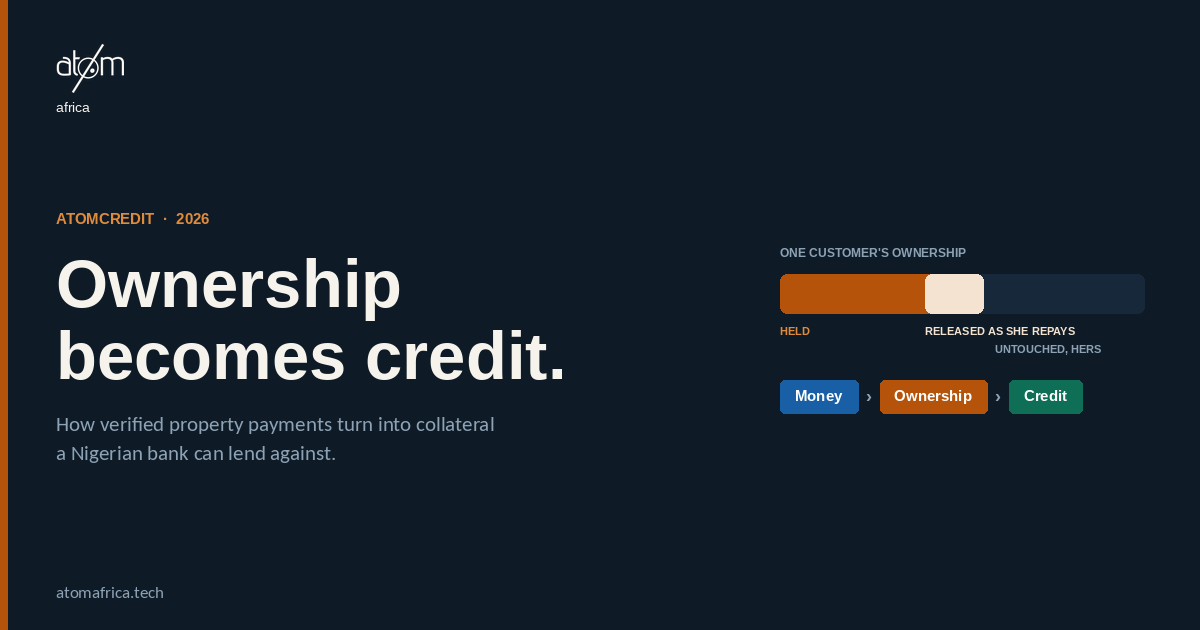
How Ownership Becomes Credit in Nigeria: The 2026 Guide to AtomCredit
Millions of Nigerians are paying for property in instalments, yet none of it counts when they need a loan, because no bank can verify what they own. This 2026 guide explains how AtomCredit turns recorded property ownership into collateral a bank can lend against: how a request is assessed, what is held and what is released, what the bank sees before deciding, how repayment returns ownership month by month, and exactly what happens if payments stop.