From Dead Capital to Working Credit: How Ownership Infrastructure Powers African Prosperity
Owning land is only half the battle. Meet the infrastructure shift that lets everyday Africans turn property into active financial power.
Economist Hernando de Soto famously pointed out decades ago that the poor in developing nations are not actually poor—they are sitting on mountains of economic potential. They have homes, land, and commercial plots.
The catch? That wealth is dead capital.
Because their property ownership lives in informal handshakes, local community ledgers, or fragile paper folders, it is invisible to the formal banking system. You cannot walk into a bank in Lagos, Nairobi, or Accra with a paper land receipt and secure a business loan to expand your enterprise. The asset sits trapped in concrete and dirt, unable to work for its owner.
Across Africa, this dead capital problem represents a multi‑trillion‑dollar bottleneck. Fixing it requires more than financial inclusion apps or higher savings rates. It requires building the missing economic bridge: ownership infrastructure that turns dead capital into working credit.
The Anatomy of Dead Capital
To understand why dead capital persists, you have to look at the massive chasm between physical real estate and formal financial institutions.
- The Information Void: Traditional banks operate on audited, verifiable data. If a customer wants a loan, the bank needs to see clean collateral history, verified titles, and predictable cash flows. In contrast, informal property markets operate on fragmented paperwork and manual record‑keeping. To a risk‑averse bank, an unverified paper title is a black box.
- The Liquidity Wall: When an everyday earner finally scrapes together enough money to buy land, their capital instantly freezes. Because the property cannot be leveraged or tokenized, it offers no secondary liquidity. It is a one‑way store of value that cannot help the owner weather an emergency or fund an opportunity.
- The Credit Deficit: Without a transparent history of property acquisition and installment compliance, millions of creditworthy individuals are treated as "unbankable." They are forced to rely on high‑interest informal lenders or remain stuck on the sidelines of economic growth.
The Infrastructure Solution: Connecting Property to Banking
You cannot solve a structural plumbing problem with a bucket. Unlocking dead capital requires building an integrated technological bridge where real estate, banking, and credit speak the exact same language.
This is the exact ecosystem model pioneered by AtomAfrica:
- Verifying the Asset (AtomOwn): Real estate developers and property networks utilize tamper‑proof digital ledgers backed by independent legal, surveying, and valuation professionals. Every square meter of land is accounted for, eliminating double allocations and establishing institutional‑grade trust.
- Empowering the Buyer (NairaPacket): Everyday citizens access verified land and housing units through structured, transparent micro‑installments where every kobo is tracked with absolute clarity.
- Unlocking the Credit Bridge (AtomCredit & AtomBank): When disciplined installment payments are recorded cleanly on a digital ownership ledger, they transform into a verifiable credit history. Partner microfinance banks and financial institutions can finally look at that property and say: "We see your asset, and we trust your payment history. Here is the capital to grow your business."
The Economic Multiplier Effect
When you systematically turn dead capital into working credit, the entire economic landscape transforms.
- For the Individual: Your land stops being a static retirement plan tucked away under a mattress. It becomes an active financial instrument—a springboard for entrepreneurship, education, and upward mobility.
- For the Financial Institution: Banks and microfinance institutions are flooded with capital but starved of reliable collateral data. Ownership infrastructure gives them the high‑integrity data they need to lend with confidence and scale their portfolios safely.
- For the Continent: Trillions of dollars in trapped real estate step out of the shadows and into the formal economy, driving sustainable GDP growth from the ground up.
Unlocking the True Wealth of Africa
Africa’s economic destiny will not be defined by how many casual payment apps we launch, but by how effectively we secure, verify, and leverage our most valuable assets.
By building robust ownership infrastructure, pioneers like AtomAfrica are bridging the gap between physical property and digital banking. When dead capital finally becomes working credit, we don't just upgrade technology—we unleash the full, unstoppable wealth‑generating power of the African people.
More on Asset-Linked Credit
Asset-Linked Credit Unlocking African Real Estate: How Asset-Backed Credit Creates Wealth
Real estate is Africa’s ultimate currency, yet its wealth remains trapped in paperwork. Explore how fixing the financial plumbing unlocks asset-backed credit for all.
Asset-Linked Credit Can You Use Land or Property as Collateral for a Loan in Nigeria?
Land is the most valuable thing many Nigerians own, but using it to get a loan isn’t always simple. Here’s how property collateral works in Nigeria, which documents banks look for, and how even partial ownership can help you access credit.
 Asset-Linked Credit
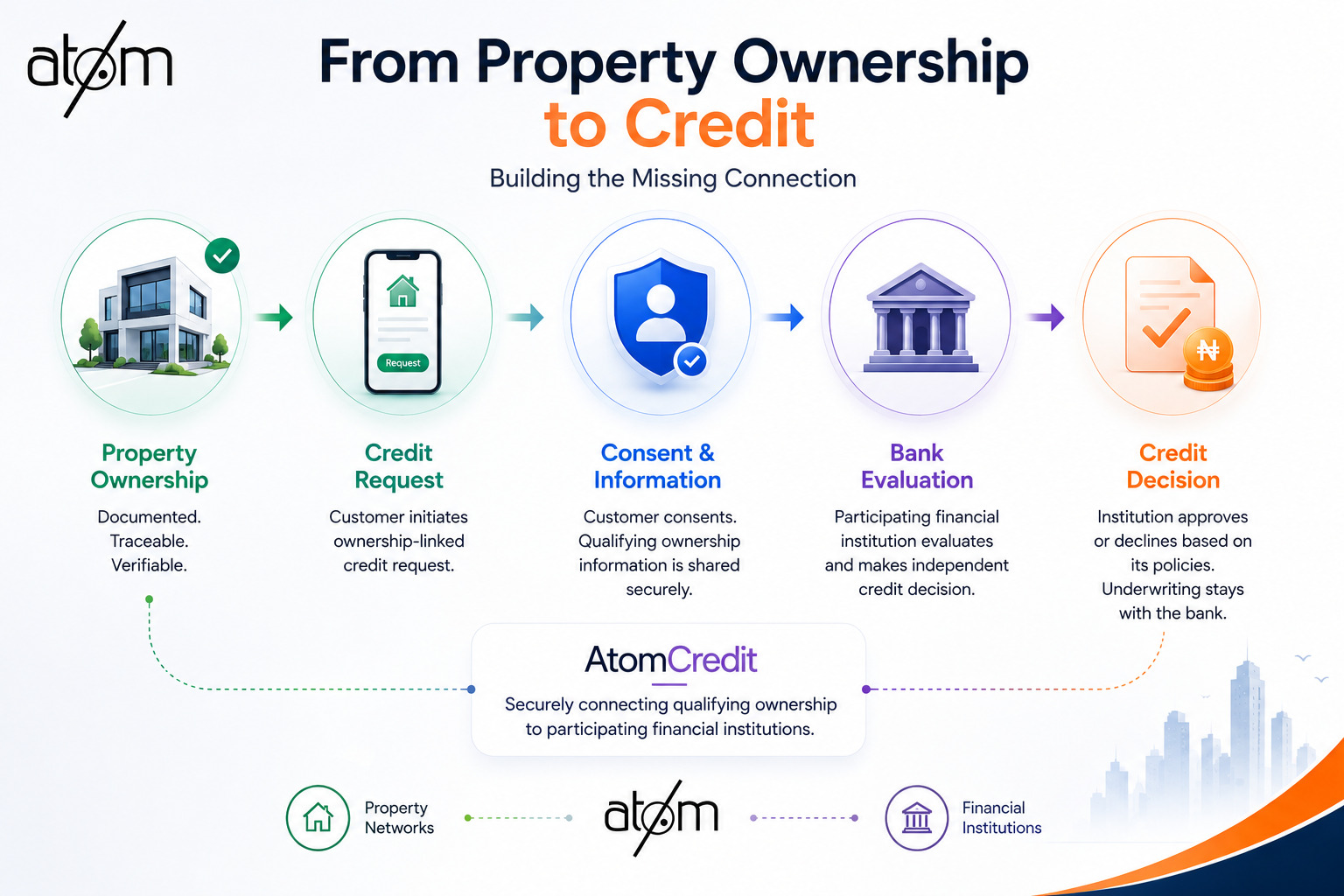
From Property Ownership to Credit: Building the Missing Connection
People can own valuable property while that ownership remains largely disconnected from the financial institutions serving them. AtomCredit is building the infrastructure for qualifying ownership information to move securely from property networks to participating financial institutions for independent credit evaluation.