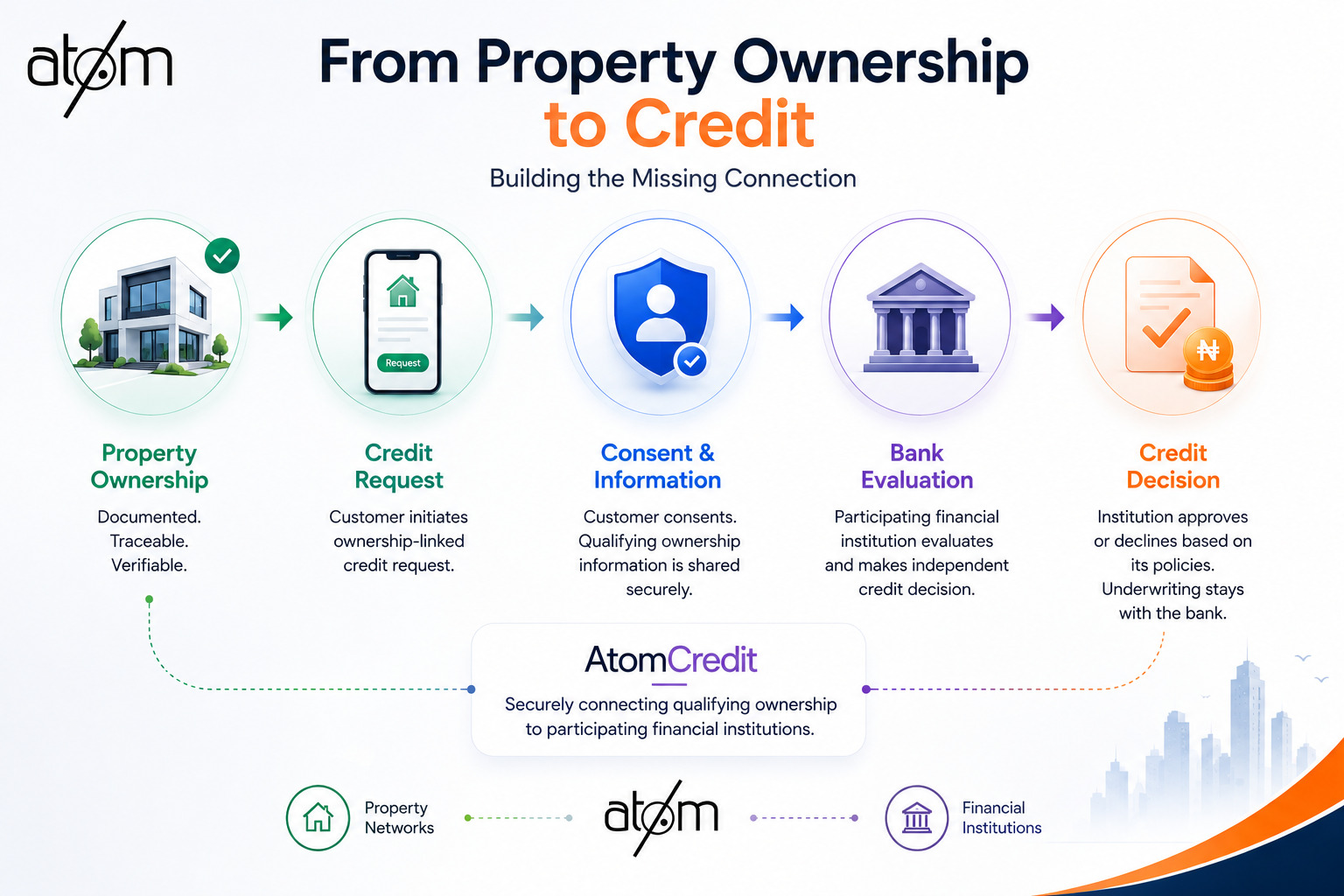
From Property Ownership to Credit: Building the Missing Connection
People can own valuable property while that ownership remains largely disconnected from the financial institutions serving them. AtomCredit is building the infrastructure for qualifying ownership information to move securely from property networks to participating financial institutions for independent credit evaluation.
A customer can have money in a bank account.
The financial institution can see deposits, withdrawals, transfers and transaction history.
The same customer may also be building valuable property ownership somewhere else.
But the financial institution may have little visibility into it.
Not because the ownership doesn't exist.
Because the systems are disconnected.
At AtomAfrica, we believe this is one of the missing connections between Africa's financial system and its ownership economy.
We're building AtomCredit to help bridge that gap.
The Financial System Understands Money Better Than Ownership
Banking has become increasingly digital.
Financial institutions have systems for recording transactions, monitoring accounts, assessing customers and managing credit.
Property ownership often exists in a very different environment.
Records may be spread across property companies, agreements, receipts, allocation documents and internal databases.
Even where ownership is legitimate, understanding exactly what someone owns, how much they own and the history behind that ownership can require significant work.
That makes ownership difficult to connect to financial services at scale.
The opportunity isn't simply to digitize another document.
It's to create better infrastructure around the ownership record itself.
It Starts With Better Ownership Records
Before ownership can become useful information to a financial institution, it needs to be sufficiently structured and traceable.
That's part of the role of AtomOwn.
Property businesses using AtomOwn can maintain structured records around properties and customer ownership.
Depending on the property and transaction, that can include information such as:
The property.
The property business.
The customer's ownership position.
Ownership transaction history.
Payments made.
Supporting property documents.
Verification and trust information.
Existing encumbrances, where applicable.
The objective is straightforward:
Move ownership from fragmented records toward information that can be more easily understood and evaluated.
But Documented Ownership Does Not Automatically Mean Credit
This distinction is fundamental to how we're building AtomAfrica.
Putting an ownership record on AtomOwn or NairaPacket does not automatically make it acceptable collateral.
It does not guarantee that a bank will lend against it.
And AtomAfrica doesn't decide whether a customer should receive credit.
Different financial institutions have different:
Risk appetites.
Credit policies.
Eligibility requirements.
Valuation requirements.
Underwriting models.
Pricing.
Loan terms.
The financial institution must remain responsible for those decisions.
Our job is to build the connection.
Introducing AtomCredit
AtomCredit is AtomAfrica's infrastructure for connecting qualifying ownership information and ownership‑linked credit requests to participating financial institutions.
The basic journey looks like this:
PROPERTY OWNERSHIP
        ↓
   CREDIT REQUEST
        ↓
 CUSTOMER CONSENT
        ↓
OWNERSHIP INFORMATION
        ↓
PARTICIPATING FINANCIAL INSTITUTION
        ↓
INDEPENDENT UNDERWRITING
        ↓
   CREDIT DECISION
The customer requests credit.
With appropriate consent, relevant ownership information can be made available to a participating financial institution.
The institution evaluates the customer and the ownership information according to its own requirements.
Then:
The financial institution decides.
AtomAfrica Provides the Connection. The Financial Institution Provides the Credit.
This is the principle behind AtomCredit.
AtomAfrica isn't trying to become every lender in the ecosystem.
Instead, we want to provide infrastructure through which participating financial institutions can evaluate opportunities coming from connected ownership networks.
The institution remains responsible for:
- Customer eligibility
- Credit assessment
- Underwriting
- Risk decisions
- Valuation requirements
- Credit limits
- Interest and pricing
- Repayment terms
- Final approval or rejection
AtomCredit provides the technological connection and workflow around the process.
What Happens When Credit Is Approved?
Where the financial institution approves an ownership‑linked credit request and the legal structure permits it, AtomCredit can also support the lifecycle around the facility.
That can include:
Encumbrance
The relevant ownership position can be marked or restricted according to the agreed credit arrangement.
↓
Credit
The participating financial institution provides the approved facility.
↓
Repayment
Repayment information can be tracked through the credit lifecycle.
↓
Release
Once the obligation has been satisfied, the applicable encumbrance can be released.
So the infrastructure isn't only about sending an application to a financial institution.
It can help maintain the connection between the credit and the qualifying ownership throughout the credit lifecycle.
Why This Matters to Financial Institutions
Financial institutions already have customers.
They already understand money.
They already have underwriting capabilities.
What they don't necessarily have is a standardized connection to the property ownership systems where some of their customers are building assets.
AtomCredit can help create that bridge.
Instead of attempting to replace the bank's credit process, AtomAfrica can provide additional permissioned information for the institution to consider alongside the information it already uses.
That could include ownership history and other qualifying ownership information from connected property networks.
The result is not automatic lending.
It's potentially better visibility for evaluation.
Why This Matters to Property Businesses
For property businesses, the opportunity goes beyond selling property.
A customer may progressively build ownership over time.
As that ownership becomes more established, the customer's property position can become an increasingly important part of their economic life.
Connecting property networks to participating financial institutions creates the possibility of extending the usefulness of that ownership.
The developer doesn't need to become a bank.
And the bank doesn't need to become a property company.
AtomAfrica provides infrastructure between them.
Why This Matters to Property Owners
Property is often one of the most significant assets people build.
Yet owning something valuable and being able to use that ownership within the wider financial system are different things.
Our goal is to help close that gap.
Imagine a customer who has spent years consistently building property ownership.
Their ownership history can show how that position developed.
Their transactions can be recorded.
Relevant documentation can be connected to the property.
And, with their consent, qualifying information can potentially be presented to a participating financial institution when they request credit.
Instead of the ownership sitting completely outside their financial relationship, there is now infrastructure through which the two can connect.
Building a Better Credit Data Loop
There is another long‑term opportunity.
As participating financial institutions evaluate ownership‑linked credit and those facilities mature, the ecosystem can begin generating useful performance data.
CREDIT APPLICATION
       ↓
INFORMATION AT APPLICATION
       ↓
BANK DECISION
       ↓
CREDIT PERFORMANCE
       ↓
REPAID / LATE / DEFAULT
       ↓
BETTER RISK DATA
Subject to appropriate consent, privacy, governance and institutional controls, this can help participating institutions build a better understanding of how different ownership and financial characteristics relate to credit performance.
Over time, that can support better risk models.
But technology should support the institution's decision‑making—not quietly replace its responsibility for lending decisions.
One Connection Between Two Ecosystems
AtomCredit becomes clearer when viewed as part of the wider AtomAfrica infrastructure.
FINANCIAL INSTITUTIONS
        │
     AtomBank
        │
     AtomCredit
        │
        ↕
     AtomAfrica
        ↕
      AtomOwn
        │
 PROPERTY NETWORKS
        │
    OWNERSHIP
AtomBank helps financial institutions operate digitally.
AtomOwn helps property businesses maintain structured ownership networks.
AtomCredit provides the connection through which qualifying ownership can be evaluated for credit.
NairaPacket provides AtomAfrica's own real‑estate ownership and distribution network.
Together, they support the larger progression:
Banking → Economic Ownership → Credit
Turning Ownership Into Better Financial Visibility
Africa doesn't lack assets.
People own property.
Property businesses hold and distribute inventory.
Financial institutions have capital and credit capabilities.
But these parts of the economy frequently operate through separate systems.
We're building the infrastructure between them.
Not every property will qualify.
Not every owner will qualify.
Not every financial institution will make the same decision.
And that's exactly why the institution must remain in control of underwriting.
AtomAfrica's role is different:
Make qualifying ownership more visible.
Make it more traceable.
Make it more verifiable.
Make it connectable.
Then allow the financial institution to evaluate it.
That's the missing connection AtomCredit is being built to provide:
From property ownership to credit — without taking the credit decision away from the financial institution.