One Country. One Vertical. Four Revenue Engines: The Market Behind AtomAfrica
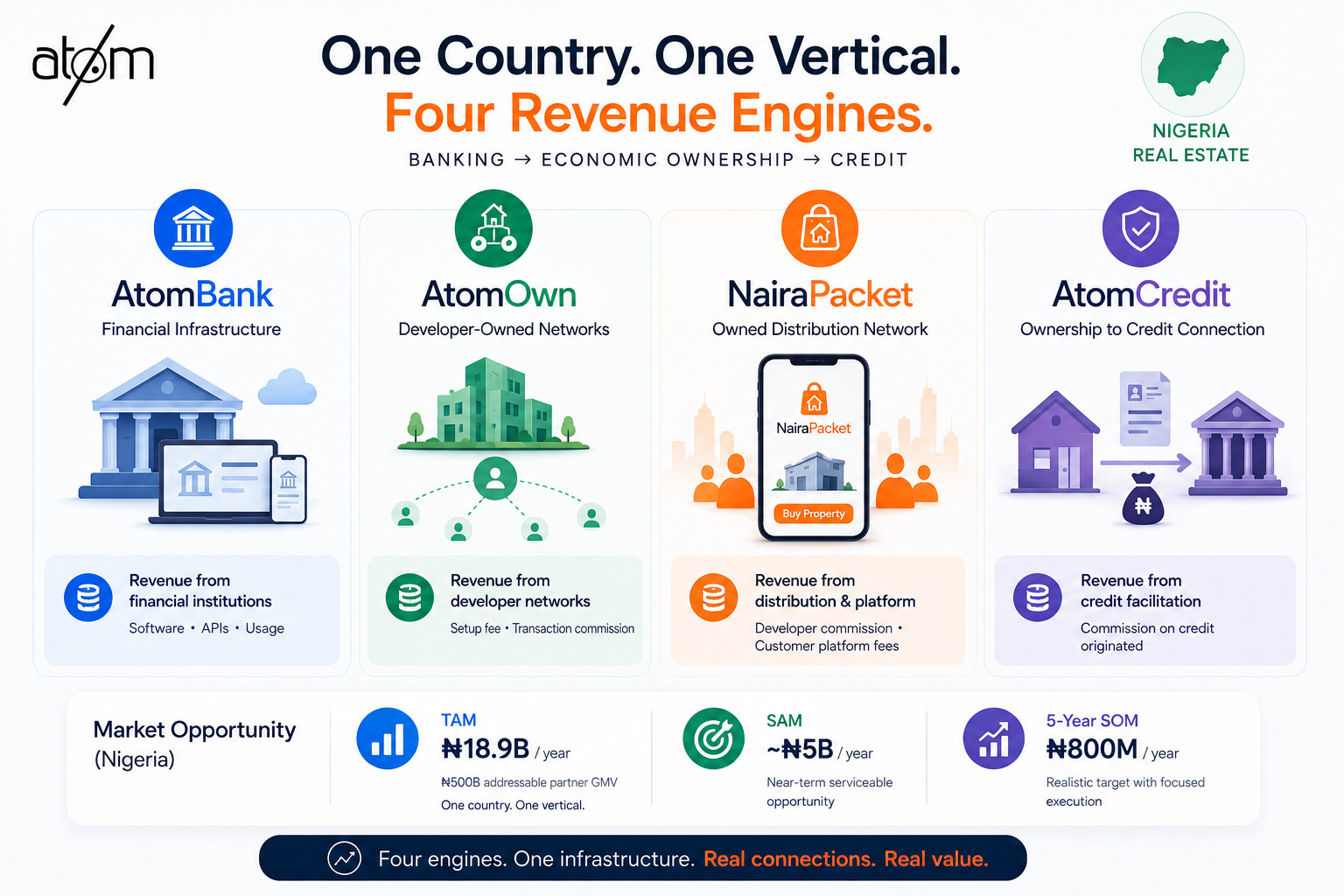
AtomAfrica is starting with one country and one ownership vertical: Nigeria and real estate. Yet our bottom-up model points to a ₦18.9 billion annual recurring market opportunity across four connected revenue engines — AtomBank, AtomOwn, NairaPacket and AtomCredit. Here is how we think about the market, what we already know, and what remains to be proven.
Big markets are easy to describe.
Building a credible path into them is harder.
At AtomAfrica, we're building infrastructure around a specific connection:
Banking → Economic Ownership → Credit
And rather than building our market thesis around every financial institution, every asset class and every African country we could eventually serve, we're starting much narrower.
One country: Nigeria.
One ownership vertical: Real estate.
Within that scope, we see four connected revenue engines:
AtomBank. AtomOwn. NairaPacket. AtomCredit.
Together, our current bottom‑up model estimates a ₦18.9 billion annual recurring Total Addressable Market (TAM) in Nigeria.
Our near‑term Serviceable Available Market (SAM) is modeled at approximately ₦5 billion annually.
And our five‑year Serviceable Obtainable Market (SOM) targets approximately ₦800 million in annual recurring revenue.
These aren't reported revenues.
They are a model of the market we believe AtomAfrica can address — built from a combination of existing commercial structures and assumptions that still need to be validated.
That distinction matters.
Four Revenue Engines
AtomAfrica isn't built around a single software subscription.
The infrastructure is designed to participate at different points across the relationship between financial institutions, property businesses and ownership.
1. AtomBank — Financial Infrastructure
AtomBank provides digital banking infrastructure to financial institutions.
Financial institutions can pay AtomAfrica for deployment, software, maintenance, APIs and usage.
This is the most established side of our infrastructure today.
AtomAfrica's banking technology has already been deployed across three Nigerian microfinance banks.
One implementation alone — VendPocket, built in partnership with Rehoboth MFB — has processed more than ₦1.5 billion in transaction value.
Our market model assumes different annual contract values depending on the type and size of financial institution.
AtomBank therefore represents the first revenue engine:
Financial institutions pay for infrastructure.
2. AtomOwn — Developer‑Owned Networks
The second engine begins with property businesses.
Instead of requiring a property developer to move its customers and operations into a central marketplace, AtomOwn enables eligible property businesses to operate their own Economic Ownership Networks.
The proposition is:
Own your infrastructure.
Their properties.
Their customers.
Their brand.
Their data.
Their network.
AtomAfrica provides the underlying infrastructure.
Our commercial model for AtomOwn combines a one‑time infrastructure setup fee with transaction revenue as activity takes place on the developer's network.
So as more property businesses connect and more ownership transactions happen across those networks, AtomAfrica can participate in that activity.
Our current market model assumes a ₦2 million setup fee and 1% transaction commission.
Those rates remain modeling assumptions and are not presented as established pricing.
AtomOwn represents the second revenue engine:
Property networks transact. AtomAfrica earns infrastructure and transaction revenue.
3. NairaPacket — AtomAfrica's Owned Distribution Network
AtomOwn gives developers their own infrastructure.
NairaPacket solves a different problem:
Distribution.
NairaPacket is AtomAfrica's wholly owned real‑estate ownership platform and our first live implementation of the progressive ownership model.
It also serves as an additional property distribution network.
A property business can therefore operate its direct business through its own AtomOwn‑powered network while making selected inventory available through NairaPacket to reach additional customers.
The two channels are complementary.
AtomOwn: Own your infrastructure.
NairaPacket: Extend your distribution.
When NairaPacket successfully distributes a property, the developer pays a 10% success commission.
Unlike several other inputs in this market model, the 10% developer commission is part of NairaPacket's stated commercial structure.
NairaPacket can also generate platform transaction revenue from customers.
For market‑sizing purposes, we currently model that customer‑side charge at 1% of applicable purchase flow. That remains an assumption until the final platform fee structure is locked.
This creates dual‑sided monetization on NairaPacket‑originated transactions:
Developer → distribution commission
Customer → applicable platform charge
But there is an important rule in our market model:
We don't count the same property transaction as both AtomOwn and NairaPacket GMV.
If NairaPacket originates the transaction, it belongs to the NairaPacket bucket.
If the transaction occurs through the developer's own network, it belongs to AtomOwn.
That prevents double‑counting between the two channels.
4. AtomCredit — Connecting Ownership to Credit
The fourth engine emerges when ownership and financial institutions connect.
AtomCredit is being built to allow qualifying ownership information and ownership‑linked credit requests to move, with appropriate consent, from participating property networks to participating financial institutions.
The institution then independently evaluates the opportunity.
AtomAfrica doesn't make the lending decision.
The financial institution retains control over:
Eligibility. Underwriting. Risk. Pricing. Terms.
Our commercial model assumes AtomAfrica earns a commission when participating financial institutions successfully originate qualifying credit through AtomCredit.
For market‑sizing purposes, we currently model:
10% credit utilization
and
1% AtomCredit commission.
Both remain assumptions.
More importantly, our TAM only applies that utilization assumption to annual connected ownership activity.
It does not assume that AtomAfrica monetizes the growing cumulative stock of ownership already recorded in the system.
That's deliberate.
Our TAM does not assume monetization of accumulated ownership balances. AtomCredit is modeled only against annual ownership activity.
Building the Market From the Bottom Up
Nigeria's overall real‑estate economy is significantly larger than the portion AtomAfrica could realistically serve.
So we don't use the entire Nigerian real‑estate sector as our addressable market.
Instead, our current model starts with:
1,000 addressable property businesses
×
₦500 million modeled average annual property sales
=
₦500 billion annual addressable partner GMV
The 1,000 businesses and ₦500 million average annual sales are modeling assumptions.
They need to be continually tested against actual developer data.
We then model how that ₦500 billion could flow through the infrastructure.
Our base case assumes:
80% through developers' own networks → ₦400B
20% originated through NairaPacket → ₦100B
The 20% NairaPacket channel share is the largest commercial assumption in the model.
We don't present it as something already achieved.
It is a hypothesis that needs to be substantiated as NairaPacket scales.
The ₦18.9 Billion Nigeria TAM
Under the base assumptions, the four engines produce:
| Revenue EngineModeled Annual TAM | |
| AtomBank | ₦3.4B |
| AtomOwn | ₦4.0B |
| NairaPacket developer commission | ₦10.0B |
| NairaPacket customer platform charges | ₦1.0B |
| AtomCredit | ₦0.5B |
| Total recurring TAM | ₦18.9B/year |
At the ₦1,339/$ conversion used in our current model, that's approximately $14.1 million in annual recurring TAM.
There is also a modeled ₦2 billion one‑time AtomOwn setup opportunity.
We deliberately keep that outside the ₦18.9 billion recurring TAM.
What If NairaPacket Doesn't Reach 20%?
This is an important question because the model shouldn't only work when its boldest assumption works.
So we stress‑tested it.
If NairaPacket captures only 5% of the modeled ₦500 billion partner GMV instead of 20%, the recurring TAM falls from ₦18.9 billion to approximately:
₦11.4 billion annually.
At 10%:
₦13.9 billion.
At our 20% base case:
₦18.9 billion.
And at 30%:
₦23.9 billion.
The point isn't that any particular percentage is guaranteed.
It's that AtomAfrica has multiple revenue engines.
If more transactions stay within developer‑owned networks, AtomOwn captures more activity.
As more transactions are originated through NairaPacket, distribution revenue increases.
AtomBank remains a separate institutional infrastructure business.
And AtomCredit creates another revenue opportunity as qualifying ownership connects to participating financial institutions.
The architecture isn't dependent on one revenue stream.
From TAM to the Market We Can Actually Serve
A large theoretical market isn't enough.
So our next layer narrows the opportunity to a more practical near‑term market.
Our SAM assumes:
400 credible property networks
×
₦300 million average modeled annual GMV
=
₦120 billion annual property GMV
Applying our current assumptions across AtomBank, AtomOwn, NairaPacket and AtomCredit produces approximately:
₦5 billion annual SAM
or roughly $3.7 million using the model's current conversion rate.
That's the market we currently view as a more realistic near‑term serviceable opportunity.
And Then Comes Execution
Our five‑year SOM is intentionally smaller again.
The model assumes:
100 property networks
50 financial institutions
and
₦25 billion annual property GMV across those networks.
At this stage, we reduce NairaPacket's modeled share from the TAM's 20% to 10%.
The resulting revenue model is:
AtomBank — ₦250M
AtomOwn — ₦225M
NairaPacket — ₦275M
AtomCredit — ₦50M
Total:
₦800 million ARR
approximately $600,000 annually at the conversion used in the model.
That represents approximately 4.2% of our modeled TAM and 16% of our modeled SAM by year five.
We also model approximately ₦200 million in cumulative one‑time setup fees separately.
What Is Real and What Is Still an Assumption?
We believe this is one of the most important distinctions to make when discussing an early infrastructure market.
Some parts of this model reflect things that already exist within AtomAfrica's commercial architecture.
Others are hypotheses.
What is already established
NairaPacket's developer success commission is 10%.
AtomAfrica's commercial architecture has four revenue engines.
Developer‑owned networks and NairaPacket are designed to coexist rather than compete.
AtomAfrica already has banking‑technology deployments across three Nigerian MFBs.
What we're still modeling
The assumption of 1,000 addressable property businesses.
The ₦500 million average annual GMV per addressable property business.
NairaPacket achieving 20% channel share in the TAM base case.
AtomOwn charging 1% transaction commission.
NairaPacket charging customers 1% on applicable purchase flow.
10% credit utilization.
AtomCredit charging participating institutions 1% on successfully originated credit.
And AtomBank's modeled annual contract values.
These aren't facts disguised as forecasts.
They're assumptions we're building, testing and refining.
One Country. One Vertical.
There is another important part of the market thesis.
The ₦18.9 billion model does not require AtomAfrica to operate across the entire continent.
It doesn't require us to connect agriculture, vehicles, equipment and every other real‑world asset.
It doesn't require us to monetize every future transaction type.
The current model is:
Nigeria only.
Real estate only.
It also excludes potential revenue from areas such as accumulated ownership‑stock credit utilization, repeat ownership purchases, secondary activity, transfers and future eligible asset classes.
That gives us room to expand the infrastructure without requiring those future opportunities to justify the current market.
The Bigger Economic Model
AtomAfrica started from a simpler business proposition:
Build and sell financial infrastructure software.
The opportunity we now see is broader.
Financial institutions need technology.
Property businesses need ownership infrastructure.
Developers need distribution.
And qualifying ownership needs a better connection to credit.
AtomAfrica can sit across those flows without having to become the bank or the property developer.
That's why we describe the business today this way:
AtomAfrica earns when financial institutions digitize, when property networks transact, when NairaPacket distributes property, and when qualifying ownership connects to credit.
Four revenue engines.
One connected infrastructure.
One country and one ownership vertical to start.
Banking → Economic Ownership → Credit.
That's the market we're building AtomAfrica to serve.
More on AtomAfrica News & Insights
 AtomAfrica News & Insights
 We Know How Much Money We Have. But Do We Know What We Own?
Africa has digitized how money moves, but much of what people own remains fragmented across documents, developers and disconnected systems. Discover why making ownership visible, traceable and connectable to finance could be the next major opportunity for financial infrastructure.
 AtomAfrica News & Insights
 AI Is Making Us More Capable. But Are We Becoming Less Capable?
AI is making software development faster and more accessible, but as we look toward the 2100 generation, we must ensure convenience does not replace learning, critical thinking and real understanding.