AI Is Making Us More Capable. But Are We Becoming Less Capable?
AI is making software development faster and more accessible, but as we look toward the 2100 generation, we must ensure convenience does not replace learning, critical thinking and real understanding.
There is something happening with AI that I find both exciting and slightly frightening.
I have spent a large part of my life learning technology.
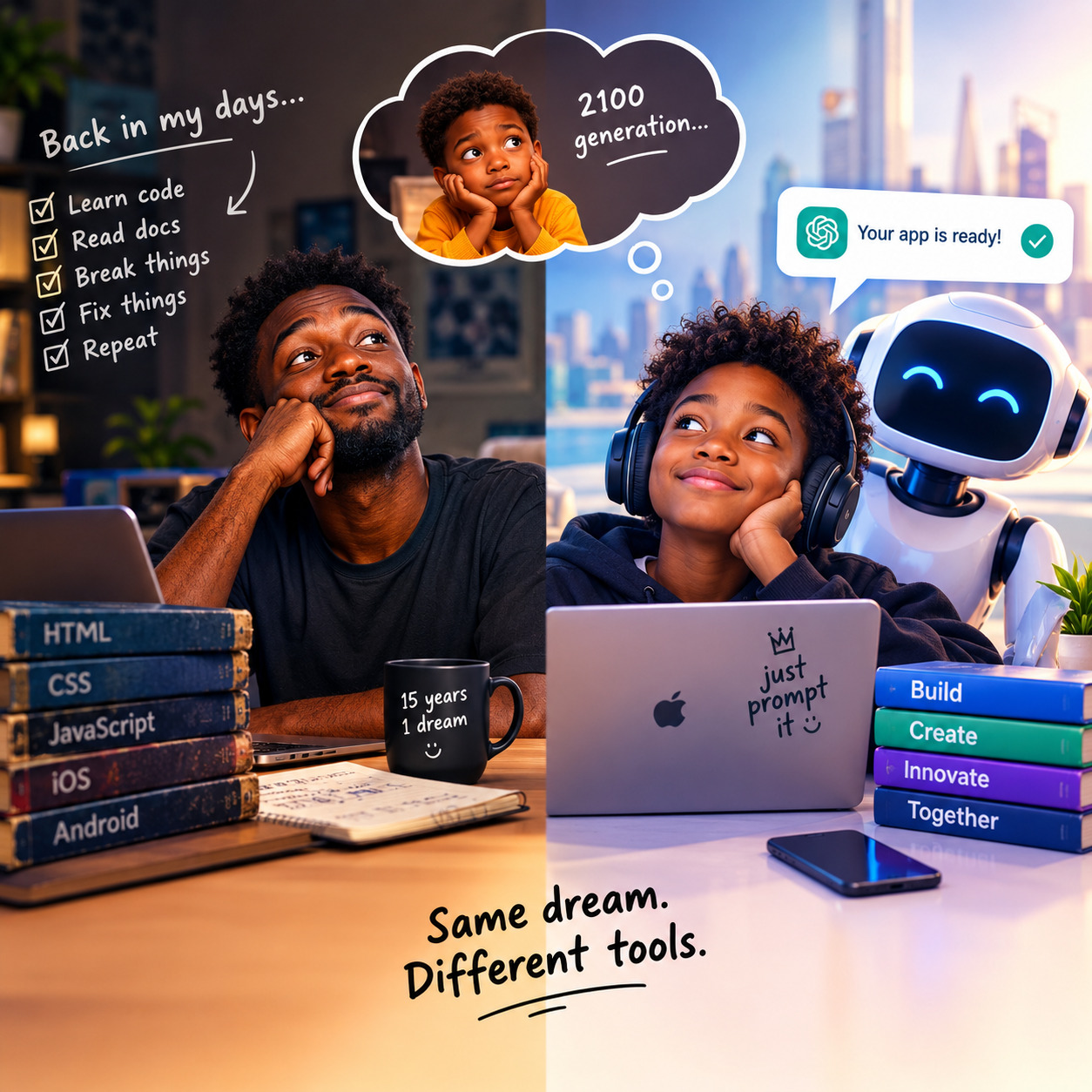
I remember when building something for Android or iOS meant spending years understanding the platforms, learning programming languages, understanding how things worked underneath, breaking things, fixing them, reading documentation, and gradually building the mental model that allowed you to create something without constantly asking someone else.
Today, someone who doesn't know what an HTML tag is can watch a tutorial, open an AI tool, describe what they want and, within hours, have something that looks surprisingly sophisticated.
That is incredible.
And honestly, it is a blessing.
AI is removing barriers that kept a lot of talented people out of technology.
Someone with a great business idea doesn't necessarily have to spend five years learning how to code before they can test it.
Someone in a small town can build something that previously required a team of engineers.
Someone who couldn't afford a developer can now prototype an idea themselves.
That is powerful.
But then I started thinking about something else.
What happens to what is inside the person's head?
If AI can always write the code, do we still learn how the code works?
If AI can explain the architecture, do we still understand architecture?
If AI can debug the application, do we still learn how to debug?
If AI can build the website, mobile app, database and API from a simple instruction, do we eventually stop developing the ability to build those things ourselves?
And this is where I become uncomfortable.
We may be entering a world where our tools are becoming more intelligent faster than we are.
A young developer today can potentially produce something that would have required a team of experienced engineers a decade ago.
But producing it and understanding it are two completely different things.
And I think that distinction is going to matter more than we realise.
The junior developer may disappear, but that doesn't necessarily mean developers have become senior.
This is the strange part.
For years, the traditional path was:
Junior → Intermediate → Senior → Architect
You learnt the fundamentals, made mistakes, understood systems, gained experience and gradually became capable of handling more complexity.
AI is disrupting that ladder.
A beginner can now jump several steps in terms of output.
They can produce a sophisticated application without having sophisticated knowledge.
But output is not the same thing as understanding.
And when something eventually breaks in a way the AI doesn't immediately solve, the person who understands the fundamentals will have a completely different advantage from the person who only knows how to ask the tool for another solution.
That is what worries me.
We shouldn't teach the next generation to compete with AI.
We should teach them to understand what AI is doing.
I don't think the answer is to tell young people:
"Don't use AI. Learn everything the old way."
That would be unrealistic.
AI is here.
And I use it myself.
The real question is whether we use AI as a crutch or as an amplifier.
There is a huge difference between:
"AI, build this for me."
and:
"I understand what I want to build. Help me build it faster."
The first can create dependency.
The second creates leverage.
And perhaps this is the skill we need to teach now.
Not memorising everything.
Not writing every line of code manually.
But developing enough understanding to question the machine.
Why did you choose this architecture?
Why is this database structure better?
What happens if 10 million people use this?
Why is this security approach safe?
What happens if this API goes down?
What assumptions are you making?
What did you get wrong?
Those questions require a brain that is still working.
There is another danger I think about.
What happens when an entire generation grows up never having to struggle with difficult problems?
Because struggle teaches something.
Spending three days trying to understand why something isn't working teaches you patience.
Reading documentation you barely understand teaches you how to learn.
Building something badly and rebuilding it teaches you judgement.
Making mistakes teaches you what not to do.
The difficult part of learning isn't always the information.
Sometimes it is the mental muscle developed while trying to obtain the information.
If AI removes all of that friction, we need to be intentional about replacing it with something else.
Otherwise, we could end up with a generation that has access to almost unlimited intelligence but has developed very little independent reasoning.
And that would be a strange future.
Maybe the old generation will know more.
But the new generation will be able to do more.
That is the paradox.
Someone from my generation may understand exactly how a system works from the database all the way to the interface.
Someone much younger may not understand half of it but may be able to build five times as much with AI.
Who is more capable?
I don't think we know yet.
Perhaps the future belongs to the person who combines both.
Deep understanding + AI leverage.
Someone who knows enough to recognise when the machine is wrong.
Someone who understands the fundamentals but doesn't waste time doing manually what a machine can do in seconds.
Someone who can build, but also knows why they are building it that way.
That person will be extremely difficult to compete with.
So, I don't think AI is necessarily a blessing or a danger.
It is both.
It is a blessing if it gives more people the ability to create.
It becomes dangerous if it removes their desire to understand.
We shouldn't be afraid that AI will make people less technical.
We should be afraid of a future where people become so dependent on AI that they stop being curious.
Because the most important skill of the next generation may not be knowing how to use AI.
It may be knowing when to look at what AI has produced and ask:
"Wait. Why does this actually work?"