Why Microfinance in Africa Needs to Go Digital
Microfinance banks are the closest thing Nigeria has to a financial system that knows its customers by name. But squeezed between fintech-shaped expectations, a regulator raising the floor, and the quiet cost of manual operations, the analog MFB is running out of decade. What real digitization looks like, and what it unlocks next.
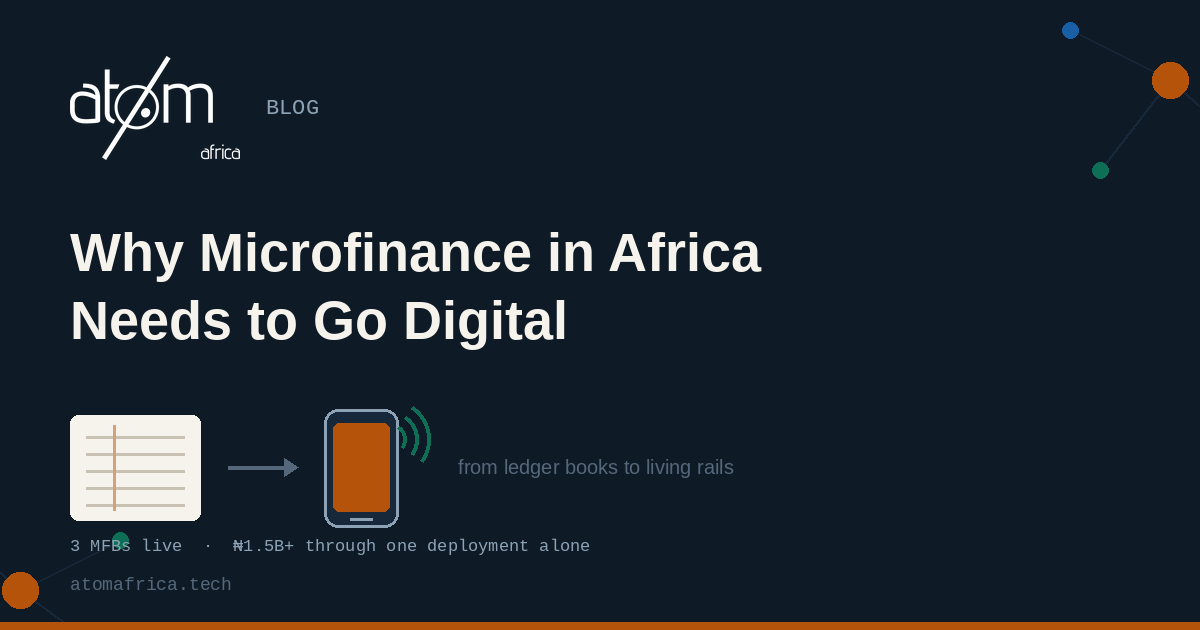
Walk into many microfinance banks across Nigeria and you will find two worlds in one room. Behind the counter: ledger books, carbon‑copy tellers, and a reconciliation process that keeps someone in the office long after closing. In front of the counter: customers holding smartphones, each one already running two or three fintech apps that move money in seconds.
The institution knows its customers by name. The apps on those phones do not, and never will. Yet every year, the gap between what customers experience elsewhere and what their microfinance bank can offer grows wider.
This is the situation African microfinance finds itself in, and it is why we believe digitization is no longer a nice‑to‑have for these institutions. It is the difference between the next decade and the last one.
Why microfinance banks matter more than they get credit for
Microfinance banks are the part of the financial system closest to real Nigeria. They bank the market trader, the artisan, the cooperative society, the smallholder. They lend on relationships and local knowledge in places where an algorithm has nothing to score.
The scale of the need is stark. Only about 6% of Nigerian adults access formal credit, even though roughly 64% are now formally financially included. The distribution exists; access to real financial products does not. Microfinance institutions sit exactly where that gap must be closed.
Which is precisely why their struggles matter so much.
The squeeze from three directions
Customers have new expectations. Fintech set the standard: instant transfers, balance at a glance, bills paid from a phone. A customer who lives that experience daily does not lower the bar when they walk into their MFB. Institutions that cannot meet it slowly lose their most active customers to the apps, keeping the costliest ones.
Regulators are raising the floor. The Central Bank of Nigeria has been steadily cleaning up the sector: 179 microfinance licences revoked in 2023, another 139 in April 2026, and 46 more in July 2026, leaving 785 licensed MFBs. Most revocations cite inactivity or insolvency. The message is unambiguous: the era of the dormant, manually run microfinance bank is ending. The institutions that remain are expected to be operationally sound, and it is difficult to be operationally sound at scale on paper records.
Manual operations are quietly expensive. Every hand‑written entry is a future reconciliation problem. Every cash‑only process caps how many customers one branch can serve. Every end‑of‑day balancing session is salary spent on work software does in seconds. The cost of staying analog rarely appears as one line item, which is exactly why it is so easy to underestimate.
Digitization is not "getting an app"
Here is where many digitization conversations go wrong. A mobile app bolted onto manual operations is decoration. Real digitization is operational: it changes how money is tracked, matched, and moved inside the institution.
In practice, that means a connected set of capabilities. Mobile and internet banking, so customers transact without a queue. Virtual accounts, so every inflow arrives already labelled and traceable. Digitized cooperative and group‑savings management, because contribution culture is the heart of this market. Automated reconciliation, so the books close themselves. And clean integration with the core banking system the institution already runs, because the core is not the problem; the layers around it are.
That last point deserves emphasis. The riskiest way for an MFB to digitize is a rip‑and‑replace core migration: long, expensive, and dangerous for an institution whose trust is its main asset. The better path builds modern capability around the existing core, so the bank modernizes without betting its stability on a big‑bang project.
We have watched this work
This is not theory for us. AtomAfrica's banking technology is deployed across three Nigerian microfinance banks: Rehoboth MFB, Sulspap MFB, and Weston‑Charis MFB, powering mobile and internet banking, cooperative platforms, virtual account services, and reconciliation tools in live operations.
One implementation alone, VendPocket, built in partnership with Rehoboth MFB, has processed over ₦1.5 billion in transaction value. That figure represents a single deployment, not the total across AtomAfrica‑powered infrastructure, and it says something simple: when a microfinance bank gets real digital rails, its customers use them.
What digitization makes possible next
There is a second reason to digitize, and in the long run it may be the bigger one.
A digitized institution does not just serve customers better today. It becomes connectable. Its records are structured, its transactions traceable, its operations legible to partners and systems beyond its own walls. That is the foundation required for the next generation of financial products, including credit evaluated against verified real‑world ownership, where institutions with digital rails will be positioned to participate and manual ones simply cannot.
In other words: digitization is how a microfinance bank secures its present, and it is also the ticket to a future where finance connects to what customers actually own.
The honest conclusion
Nobody should pretend digitization is effortless. It requires budget, training, and a leadership decision to change how work is done. But the alternative is now clearly worse: shrinking relevance with customers, rising friction with regulators, and exclusion from where financial infrastructure is heading.
The microfinance banks that thrive in the next decade will be the ones that kept everything that made them valuable, the relationships, the local knowledge, the trust, and rebuilt everything that held them back.
The relationships were never the problem. The rails were.
AtomAfrica builds digital banking infrastructure for African financial institutions: AtomBank, deployed across three Nigerian MFBs, alongside AtomOwn and AtomCredit, connecting finance to economic ownership. To talk about digitizing your institution, visit atomafrica.tech.
More on Financial Infrastructure & Policy
 Financial Infrastructure & Policy
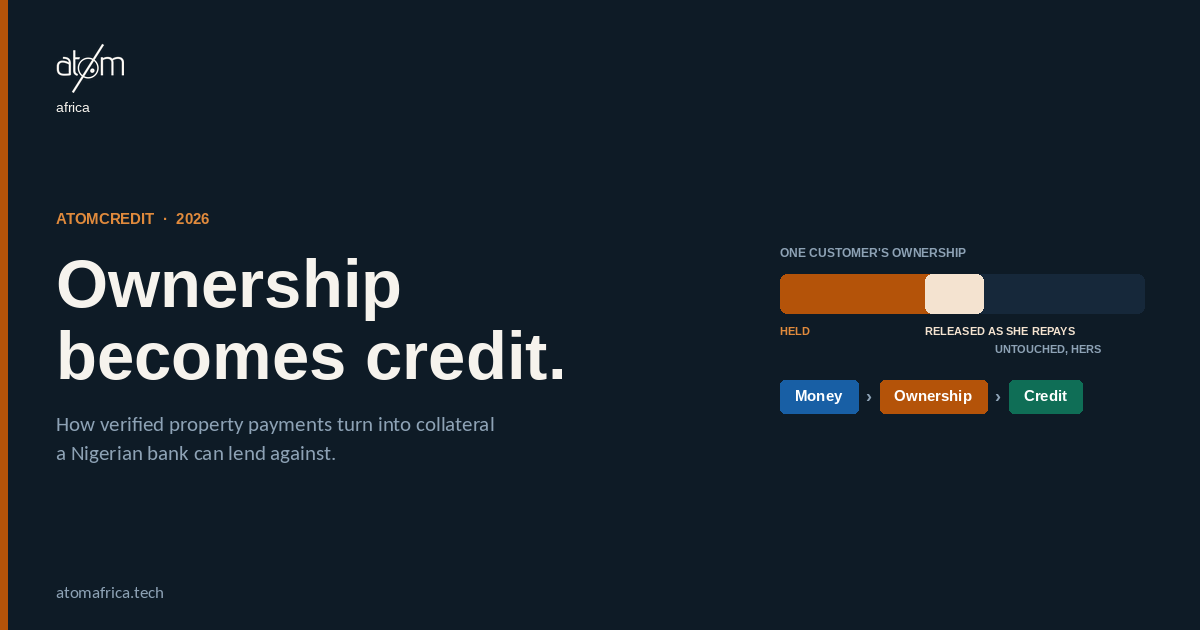
 How Ownership Becomes Credit in Nigeria: The 2026 Guide to AtomCredit
Millions of Nigerians are paying for property in instalments, yet none of it counts when they need a loan, because no bank can verify what they own. This 2026 guide explains how AtomCredit turns recorded property ownership into collateral a bank can lend against: how a request is assessed, what is held and what is released, what the bank sees before deciding, how repayment returns ownership month by month, and exactly what happens if payments stop.
 Financial Infrastructure & Policy
 Why Africa’s Financial Infrastructure Is Moving Beyond Payments
AtomAfrica is building financial infrastructure that connects banking, economic ownership and credit. With AtomOwn, NairaPacket and AtomCredit, the company is building a bridge between financial institutions, property businesses and the assets people own.
 Financial Infrastructure & Policy
 When Companies Lose Value, What Does It Say About Ownership in Nigeria?
The financial distress facing nine companies on the NGX raises a bigger question: what does ownership really mean? As Africa moves beyond simply moving money, the next opportunity is helping more people turn money into productive assets and participate in the ownership of the real economy.