Payments Worked. Now What? Fintech as Economic Infrastructure | AtomAfrica
AtomAfrica founder Oladipupo Muideen Olaide on why Nigerian fintech must move beyond payments, and what it takes to turn transactions into ownership and credit.
A woman in Onitsha market sells fabric. Every day, customers pay her by transfer. The money lands in seconds. Nobody in that market doubts that digital payments work anymore.
But ask her bank if she qualifies for a loan to double her stock, and the conversation slows down. Ask whether her contribution savings toward a plot of land count for anything, and it stops.
The money moved. The value it created did not.
That is the gap I have been working on for years. So when Lagos State Deputy Governor Dr. Obafemi Hamzat stood before the industry at Nigeria Fintech Week 2026 and said fintech must now move beyond payments into credit, insurance, savings and wider economic activity, I paid attention. (Nairametrics)
He is right. And it is worth saying plainly what that actually requires.
The rails are built
The numbers are not in dispute. Citing the CBN's 2026 Fintech Report, the Deputy Governor pointed out that NIBSS Instant Payment volumes grew from about 5 billion transactions in 2022 to close to 11 billion in 2024.
That is not a payments statistic. That is a national financial layer running under the economy.
Policy is moving the same way. The National Payment Stack has completed its pilot. The CBN's Payment System Vision 2028 is targeting 95% financial inclusion by 2028.
So the question is no longer whether Nigerians will pay digitally. They already do. The question is what those payments can now unlock.
Every transfer is a record
This was the strongest point in his remarks. When a merchant receives payments digitally, she is creating a record of her business. When a company invoices and collects digitally, it is building a financial history.
Here is what I have learned building for banks: most Nigerians are not unbankable. They are unrecorded.
A lender cannot price what it cannot see. Give it verified records, and credit, insurance and savings products can be built on real behaviour, not guesswork.
Or as the Deputy Governor put it, the next generation of fintech can "make the economy more intelligent."
Where the gap really sits
The payment rails are strong. What sits between those rails and real outcomes is still thin. I see it in two places every week.
Microfinance banks. MFBs serve the people closest to the real economy: traders, cooperatives, contribution groups. Many are still running on limited technology. Slow reconciliation. Weak digital channels. No easy way to plug into new products.
Real assets. Millions of Nigerians save through Ajo, Esusu, cooperatives and workplace schemes, and a lot of that money is meant for property. But ownership lives in drawers. Allocation letters, receipts, photocopies. Nobody outside the buyer and the developer can confidently verify it.
An asset nobody can verify cannot support credit. That is not a payments problem. It is an infrastructure problem.
What we are building at AtomAfrica
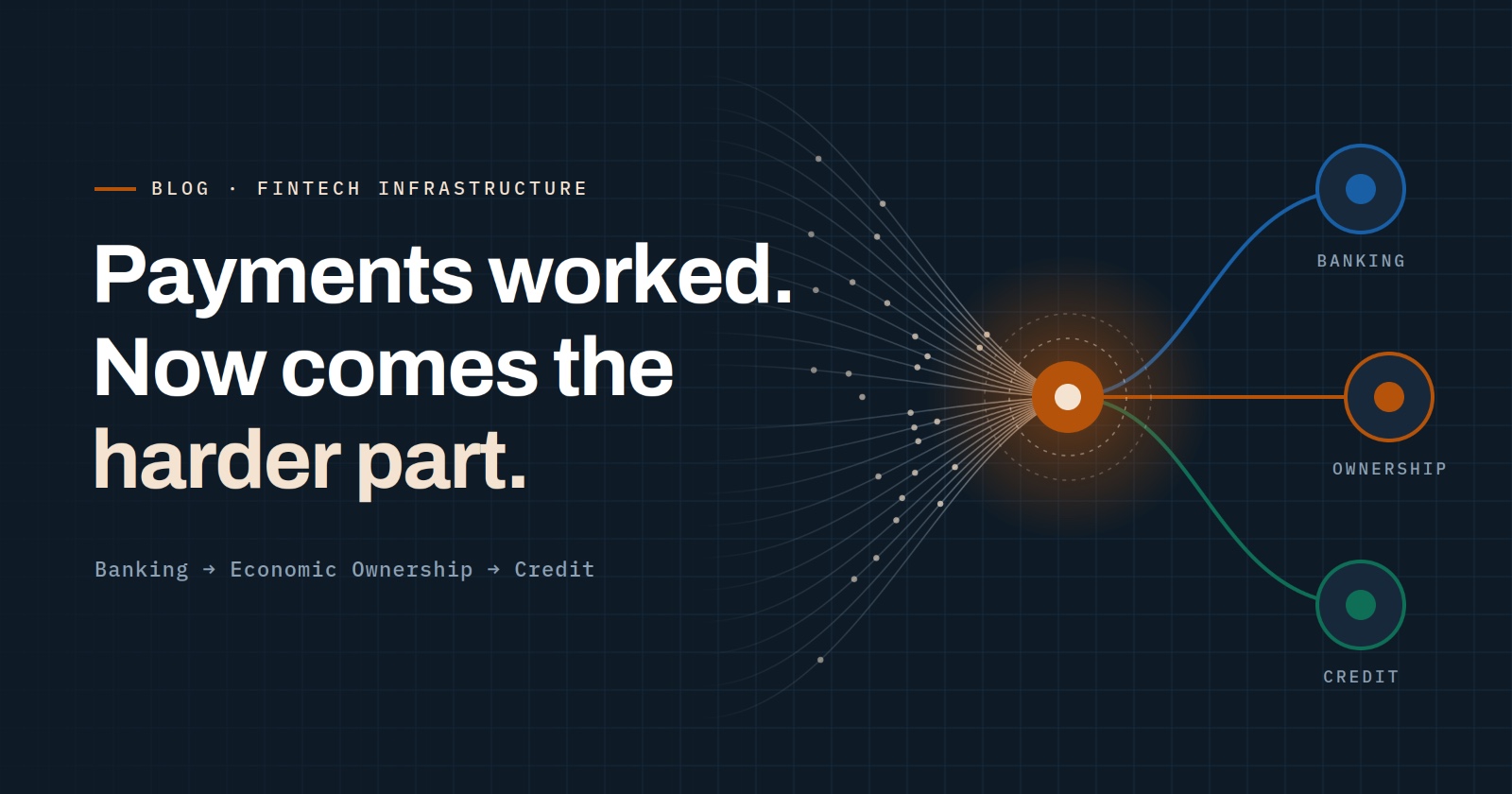
At AtomAfrica, we think about it in three layers: Banking → Economic Ownership → Credit.
AtomBank is the banking layer. Today it powers three live microfinance banks: Rehoboth MFB, Sulspap MFB and Weston‑Charis MFB, with mobile and internet banking, cooperative platforms, virtual accounts and reconciliation automation. One implementation alone, VendPocket, built in partnership with Rehoboth MFB, processed over ₦1.5 billion in transaction value in its first six months.*
AtomOwn is the ownership layer. It gives real estate developers their own digital ownership network, where customers buy progressively and every payment builds a verified ownership record. Six real estate companies have signed to manage their verified property on AtomAfrica infrastructure, with over ₦2 billion worth of property assets listed.
AtomCredit is the credit layer. It connects verified ownership to participating lenders. The bank still makes the lending decision. We give it a record it can trust.
NairaPacket, our consumer platform, is the first place all of this comes together. It turns contribution savings into real estate ownership, starting from ₦10,000.
None of this replaces what the payments industry built. It stands on it.
From adoption to productivity
The Deputy Governor described the shift as moving from digital adoption to digital productivity. I agree, and I think it is the most important sentence said to this industry this year.
The first era of Nigerian fintech moved money.
The next era will be judged by what that money builds: stock for the trader, a title for the saver, a loan the bank can actually approve.
That is the work. We are already doing it.
Frequently asked questions
What does "fintech as economic infrastructure" mean?
It means using the payment rails Nigeria has already built to power credit, savings, insurance and ownership, not just transfers.
Why do microfinance banks matter to this shift?
MFBs serve the traders, cooperatives and savings groups at the centre of Nigeria's real economy. Modern infrastructure lets them turn everyday transactions into deposits, data and lending.
How can property become a basis for credit?
When ownership is recorded digitally and verified, a participating lender can see and evaluate it. That is what AtomOwn and AtomCredit are designed to do.
Who is AtomAfrica for?
Banks, microfinance banks and asset businesses such as real estate developers. AtomAfrica is backed by 35°N Ventures.
If you run a bank, an MFB or a real estate business and you want your transactions to build something, let us talk. Visit atomafrica.tech.
*₦1.5B+ reflects VendPocket transaction value only, not total volume across all AtomAfrica‑powered infrastructure.
More on Economic Ownership
 Economic Ownership
 Diaspora Property Ownership Nigeria 2026: How Nigerians Abroad Can Own Property Back Home
For Nigerians abroad, owning property back home doesn't always have to start with millions. Explore practical routes to diaspora property ownership in Nigeria in 2026, including mortgages, payment plans, joint ownership and progressive property ownership.
Economic Ownership How Nigerians Abroad Can Own Property in Nigeria by Paying Small Small
Living in the UK, USA, Canada or elsewhere doesn't mean you have to wait until you have millions before owning property back home. From diaspora mortgages and group ownership to progressive property ownership, here are practical ways Nigerians abroad can start building property ownership in Nigeria, even by paying gradually.
Economic Ownership What Are the Four Types of Real Estate Investments?
Real estate investment is more than buying land and waiting for the price to rise. From residential apartments and commercial properties to industrial facilities and land, here are the four major types of real estate investments and how each one works.