Money Moves. Ownership Builds. The Missing Infrastructure Between Them
Africa has built the rails for moving money. The next challenge is connecting those payments to what they create: property, ownership and ultimately credit.
For years, Africa's financial technology story has focused on one question:
How do we move money better?
The answer has transformed how millions of people live.
People can transfer money from their phones.
Businesses can collect payments digitally.
Financial institutions can serve customers through mobile apps.
Money can move between accounts in seconds.
But there is another question that is becoming increasingly important:
What does the money become after it moves?
Because money rarely exists only as money.
It becomes a house.
It becomes land.
It becomes a business.
It becomes equipment.
It becomes inventory.
It becomes an ownership stake.
It becomes something that can shape a person's economic future.
The financial system has become very good at recording the movement of money.
The next infrastructure challenge is recording and connecting what that money builds.
The gap between a transaction and an asset
Consider a simple example.
A customer earns money and keeps ₦100,000 in a bank account.
The bank can see the balance.
The bank can see deposits.
The bank can see transfers.
The bank can see transaction history.
Now imagine that the customer uses part of that money every month to build ownership in a property.
After several months, the customer has accumulated a meaningful ownership position.
The property company knows what the customer has paid.
The property company knows which property those payments relate to.
The customer knows what they are building.
But the bank may still only see the money leaving the account.
The financial system can see the transaction.
It cannot necessarily see the ownership created by the transaction.
That is the gap.
And it is much bigger than real estate.
Africa has built the rails for money
The progress in African financial technology should not be underestimated.
Digital payments have changed consumer behaviour.
Mobile banking has reduced dependence on physical branches.
Financial institutions have gained better tools for collecting and reconciling payments.
Customers increasingly expect financial services to be available through their phones.
AtomAfrica's own banking infrastructure reflects this evolution. AtomBank provides digital banking capabilities including mobile and internet banking, virtual accounts, payments, reconciliation and integrations with existing core banking systems. It is already live with three Nigerian microfinance banks, while one implementation, VendPocket built with Rehoboth MFB, has processed more than ₦1.5 billion in transaction value.
This is important because it shows that the problem is no longer simply getting money onto digital rails.
Those rails exist.
The next question is what we connect to them.
The economy is bigger than the bank account
A person's economic life does not stop at their bank balance.
Someone can have relatively little cash in an account while owning a valuable property.
Another person can have years of payments toward an asset.
A business can own productive equipment.
A property company can have hundreds of customers building ownership over time.
A customer can have financial activity in one institution and ownership records somewhere completely different.
The problem is not necessarily that these assets lack value.
The problem is that the information around them is often fragmented.
The bank has one record.
The property business has another.
The customer may have another.
Legal documents may exist somewhere else.
Payment records may sit in another system.
When these systems cannot communicate, ownership becomes difficult to understand outside the organisation that created the record.
That limits what the financial system can do with it.
This is where ownership infrastructure matters
At AtomAfrica, we think economic ownership needs its own infrastructure.
Not another marketplace.
Not another payment app.
Not simply another property website.
Infrastructure.
A system that can help property businesses record who owns what, how ownership changes, what payments created that ownership and what documentation supports the record.
That is the role AtomOwn is designed to play.
With AtomOwn, a property company can operate its own branded digital ownership network. Its properties, customers, brand and ownership records remain within its own network, while AtomAfrica provides the technology underneath it.
This creates an important shift.
The property company is no longer simply selling a property.
It is maintaining a digital relationship around ownership.
From payment history to ownership history
This distinction matters.
Imagine a customer paying ₦50,000 every month toward a property.
A traditional payment system might record:
₦50,000 received.
Then another:
₦50,000 received.
Then another.
But an ownership system should be able to answer a different question:
What does the customer now own because of those payments?
That is a much more useful record.
The payment is the event.
Ownership is the outcome.
The infrastructure needs to connect the two.
This is why AtomAfrica's model moves from:
Banking → Economic Ownership → Credit
Banking records and moves the money.
Ownership records what the money builds.
Credit creates a potential financial use for qualifying ownership.
Each layer can operate independently.
But the real opportunity appears when they can work together.
What happens when ownership becomes visible?
Now imagine the same customer has built a verified ownership position.
The customer wants to access credit.
The question is no longer simply:
“Do you have money in your account?”
The financial institution can potentially ask:
“What do you own?”
That does not mean every asset automatically becomes collateral.
It does not mean every owner qualifies for a loan.
And it does not mean AtomAfrica decides who receives credit.
The financial institution remains responsible for underwriting, risk, pricing, eligibility and terms. AtomAfrica provides the infrastructure connecting qualifying ownership information to participating financial institutions.
That distinction is critical.
Technology does not replace the bank.
It gives the bank better information to work with.
The three systems that have traditionally lived apart
Think about the financial life of a property owner.
There is the bank.
It knows about the customer's money.
There is the property business.
It knows about the customer's property and ownership.
Then there is the customer.
The customer lives across both systems.
The customer may be paying for a property from their bank account every month, but the two systems do not necessarily understand the same story.
AtomAfrica's opportunity is to connect them.
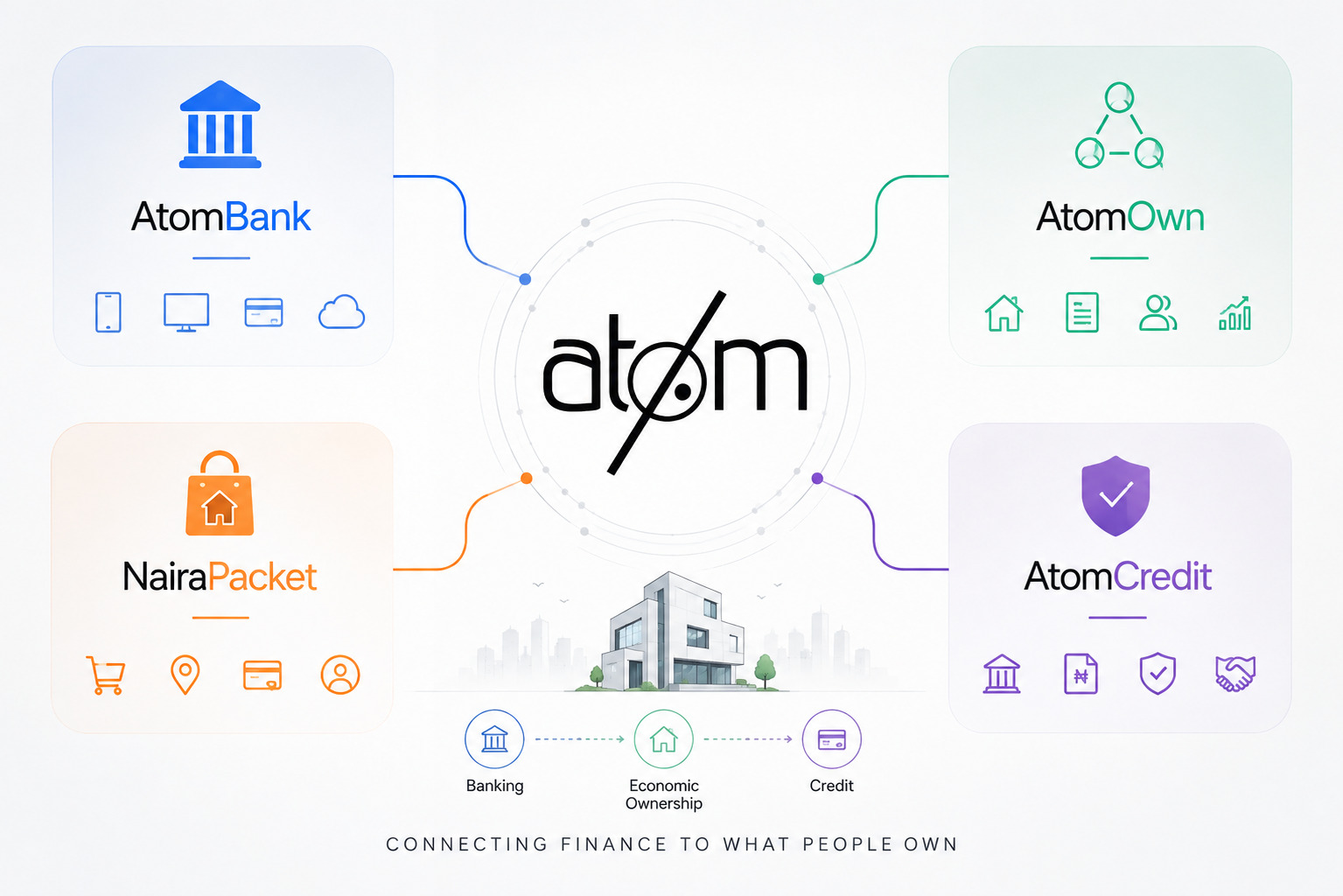
AtomBank
The financial infrastructure.
It helps financial institutions digitize banking, payments, collections and reconciliation while working with the core systems they already use.
AtomOwn
The ownership infrastructure.
It helps property businesses manage their properties, customers, payments and ownership records through their own branded networks.
AtomCredit
The connection.
It enables qualifying ownership information to be connected to participating financial institutions for independent credit evaluation.
Together, the model becomes much easier to understand:
Money → Ownership → Credit
The customer should not have to think about the infrastructure
This is perhaps the most important part.
A customer does not care which database talks to which API.
They do not care how the banking system reconciles a payment.
They do not care which infrastructure provider maintains the ownership ledger.
They simply want things to work.
They want to know:
Where is my money?
What do I own?
How much have I built?
Can I prove it?
What can I do with it?
The infrastructure should make those answers easier.
The complexity belongs underneath the experience.
This changes the role of the property business
Property businesses have traditionally been focused on selling inventory.
Find a buyer.
Collect payment.
Issue documents.
Complete the transaction.
But digital ownership infrastructure allows the relationship to continue beyond the sale.
The property company can manage:
- Property inventory
- Customers
- Payments
- Ownership records
- Ownership history
- Verification
- Transfers
- Customer access
- Financial connectivity
The property business therefore becomes more than a seller.
It becomes part of an ownership network.
That is why AtomOwn is deliberately positioned as a network rather than a marketplace. Marketplaces distribute listings. An ownership network creates an ongoing digital relationship around what customers own.
The bigger opportunity is not property
Real estate is where AtomAfrica is starting.
That is deliberate.
Property is one of the clearest examples of an asset that people want to own, often build toward gradually, and potentially use within broader financial relationships.
But the underlying infrastructure idea is larger.
The question is:
Can financial infrastructure connect to real‑world ownership?
Today, the first application is property.
Tomorrow, the same infrastructure model can potentially extend to other forms of economic ownership.
The category is bigger than real estate.
The infrastructure starts with real estate because that is where the problem is immediate and tangible.
Africa's next financial infrastructure layer
The first generation of fintech answered:
How can money move?
The next generation should increasingly answer:
What does the money become?
That is a fundamentally different question.
Moving ₦1 million from one account to another is a transaction.
Using that ₦1 million to build ownership in a productive asset is an economic event.
Recording that ownership is an infrastructure problem.
Making that ownership verifiable is a trust problem.
Connecting that ownership to financial institutions is a financial infrastructure problem.
And allowing a financial institution to independently decide whether that ownership can support credit is a lending problem.
These problems are connected.
But they should not all be solved by the same institution.
That is why infrastructure matters.
The connection is the product
AtomAfrica's thesis is ultimately simple.
Financial institutions already understand money.
Property businesses already understand property.
Customers already know what they want to own.
What is missing is the infrastructure connecting these worlds.
AtomAfrica is building that connection through banking, economic ownership and credit.
The goal is not simply to make money move faster.
It is to make the economic journey after the transaction more visible, structured and useful.
Because the most important financial event may not be the moment money leaves your account.
It may be what that money becomes.
Money moves.
Ownership builds.
Infrastructure connects the two.
That is the next layer of financial infrastructure AtomAfrica is building.
Banking → Economic Ownership → Credit.
And ultimately:
The infrastructure for what money becomes.
More on Real Estate Infrastructure
Real Estate Infrastructure Nigeria’s Real Estate Market Is Going Digital. The Next Question Is What Happens to Ownership
Nigeria’s real estate industry is entering a more connected digital era. As marketplaces bring property stakeholders online, the next infrastructure challenge is making ownership itself more digital, traceable and connected to financial services.
Real Estate Infrastructure How to Invest in Real Estate With Little Money in Nigeria
You don't need millions before you can start thinking about real estate in Nigeria. From cooperatives and joint ownership to REITs and gradual property ownership, there are different ways to start with little money. The important question is: do you want to invest in real estate, or do you actually want to own it?
 Real Estate Infrastructure
 AtomAfrica: Building the Infrastructure Connecting Finance to What People Own
Africa has built powerful infrastructure for moving money. But the connection between the financial system and what people own remains fragmented. AtomAfrica is building that missing infrastructure — connecting Banking → Economic Ownership → Credit, starting with real estate.