Nigeria’s Real Estate Market Is Going Digital. The Next Question Is What Happens to Ownership
Nigeria’s real estate industry is entering a more connected digital era. As marketplaces bring property stakeholders online, the next infrastructure challenge is making ownership itself more digital, traceable and connected to financial services.
Nigeria's real estate industry is entering a new phase.
The shift is not simply about putting properties online.
It is about building digital systems that can connect the different people and businesses involved in how property is discovered, sold, managed and eventually owned.
A recent report by Vanguard highlights this direction. BettaBuilder Marketplace, a Nigerian construction and real estate technology company, is scheduled to launch a digital marketplace designed to bring together property developers, architects, engineers, quantity surveyors, contractors, homeowners, technology professionals and other stakeholders across the industry. The launch is scheduled for October 1, 2026, in Lagos.
That development is important for one reason:
Real estate is becoming more digital.
But there is a bigger question underneath it.
What happens to the ownership after the transaction?
A marketplace solves discovery. Ownership needs infrastructure too.
Digital marketplaces are useful because they bring fragmented participants into one environment.
A buyer can discover a property.
A developer can reach customers.
Professionals can find opportunities.
Different stakeholders can interact through digital channels instead of relying entirely on disconnected offline processes.
But buying or paying for property is only one part of the journey.
The more important record is what that payment eventually represents.
If someone pays ₦100,000 toward a property, there are several things that need to remain connected:
- Who made the payment?
- What property was the payment for?
- How much ownership has been built?
- What documentation supports that ownership?
- What has already been paid?
- What remains?
- Has the ownership been verified?
- Are there any existing claims against it?
- What happens if the owner wants to transfer it?
- Could that ownership eventually be relevant to a financial institution?
A marketplace can help answer the first question:
What property is available?
The next layer of infrastructure needs to answer:
What does the customer actually own?
That is a different problem.
The real estate industry does not only need digital listings
One of the biggest opportunities in African real estate technology is moving beyond digitising listings and transactions.
The deeper opportunity is digitising the ownership relationship.
Consider a simple example.
A customer wants to acquire a plot of land but cannot pay the entire amount at once.
They make a first payment of ₦100,000.
Then another ₦150,000.
Then another ₦200,000.
If the systems are properly connected, every payment should do more than appear as a transaction.
It should build a record.
The financial system sees the money movement.
The property company sees the payment against the customer's property.
The customer sees the ownership they are building.
That is where financial infrastructure and ownership infrastructure begin to meet.
At AtomAfrica, we describe this as:
Money → Ownership → Credit
This is the infrastructure layer behind digital property
AtomAfrica is building infrastructure connecting payments to property, ownership and credit.
The idea is simple.
Financial institutions already have systems that understand money.
Property businesses already have systems that understand their properties and customers.
What is often missing is the connection between the two.
AtomAfrica is building that connection.
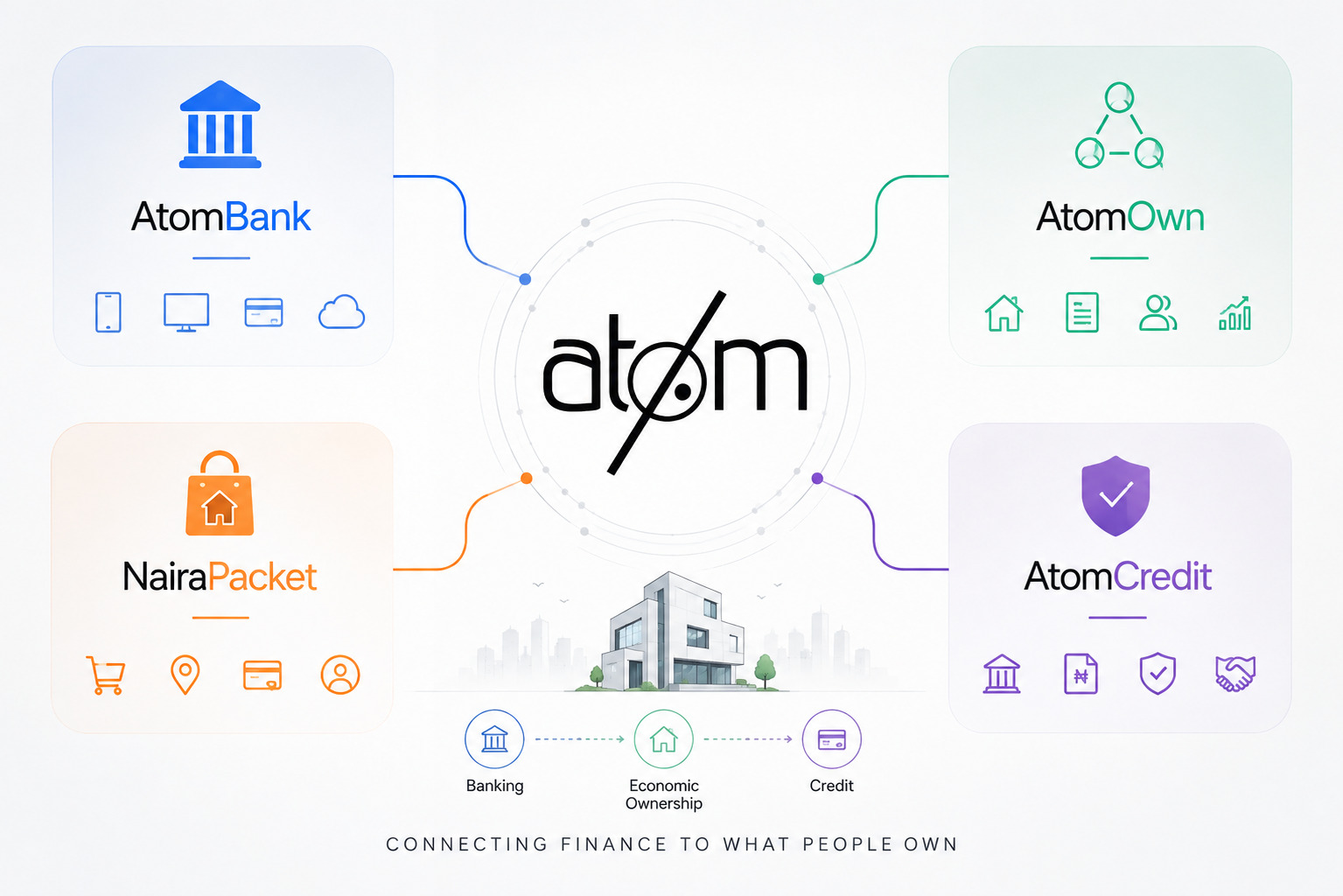
Our current infrastructure is organised around three layers:
AtomBank for digital banking infrastructure.
AtomOwn for economic ownership infrastructure.
AtomCredit for connecting qualifying ownership to participating financial institutions for credit evaluation.
Each layer can stand on its own.
Together, they create a connection between money, ownership and financial services.
From property payment to ownership record
This becomes particularly important as real estate moves toward progressive ownership.
A person does not always acquire property with one large payment.
They may build ownership gradually.
That means the system needs to understand not just the final transaction, but the journey.
For example:
Customer pays ₦100,000
↓
Payment is recorded
↓
Property is identified
↓
Ownership position is updated
↓
Supporting documentation remains connected
↓
Ownership history grows over time
That creates something more useful than a payment receipt.
It creates a structured ownership record.
AtomOwn is designed around this idea, giving eligible property businesses their own digital economic ownership networks while maintaining ownership records around their properties and customers. AtomAfrica's Trust Standards cover areas including documentation, legal verification, ownership rights, valuation, ownership history and encumbrance records.
Why ownership records matter to financial institutions
There is another reason this matters.
Banks understand customers through financial information.
They can see deposits, transfers, repayments and other financial activity.
But a customer's economic life is larger than their bank account.
Someone may also own property.
The problem is that this ownership can exist in a completely separate system.
A property company may know exactly what the customer owns.
The bank may know exactly how the customer moves money.
But neither system necessarily has a structured connection to the other.
This is the gap that infrastructure can address.
With appropriate customer consent and subject to the participating institution's requirements, qualifying ownership information can potentially be connected to financial institutions for independent evaluation.
That is the role AtomCredit is being built to support.
The financial institution remains responsible for eligibility, underwriting, risk, pricing and terms.
AtomAfrica provides the connection. The financial institution provides the credit.
The next evolution of Nigerian PropTech
The first phase of PropTech was largely about putting property information online.
Then came digital property transactions.
Now the opportunity is becoming broader.
The industry can begin connecting:
Property discovery
↓
Property transaction
↓
Ownership record
↓
Ownership verification
↓
Financial connectivity
That does not mean every property automatically becomes financeable.
It does not mean every owner qualifies for credit.
And it does not mean technology replaces lawyers, valuers, regulators, property companies or financial institutions.
It means the information connecting these participants can become more structured.
That distinction matters.
Marketplaces and infrastructure can grow together
The emergence of more digital real estate marketplaces in Nigeria should not be viewed as a replacement for other parts of the PropTech ecosystem.
It can be part of a much larger digital transformation.
A marketplace can help bring stakeholders together.
Property management systems can organise operations.
Payment infrastructure can move money.
Ownership infrastructure can maintain what those payments represent.
Financial infrastructure can connect qualifying ownership to financial services.
Each solves a different part of the problem.
The opportunity is in making these systems work together.
Africa already built the rails for moving money
Africa has spent years building better infrastructure for payments and banking.
Mobile banking expanded.
Digital payments became normal.
Transfers became faster.
Financial institutions became more digitally connected.
The next question is what happens after the money moves.
Because money is rarely the final destination.
Money becomes something.
It becomes property.
It becomes equipment.
It becomes a business.
It becomes an asset.
It becomes ownership.
And that ownership can become economically useful in ways that are difficult to support when it remains trapped in fragmented records.
That is why we believe the next infrastructure opportunity is not simply about moving money.
It is about connecting money to what it becomes.
Real estate is the starting point
AtomAfrica is starting with real estate because it is an area where the need for structured ownership is especially clear.
Our own experience through NairaPacket has given us a live environment for building and testing progressive property ownership.
NairaPacket is AtomAfrica's own real‑estate ownership platform and the first live example of the model. AtomAfrica's wider infrastructure allows the same principles to be extended to property businesses that want to operate their own ownership networks.
The longer‑term infrastructure can extend beyond real estate.
Agriculture.
Equipment.
Energy.
Vehicles.
But the starting point is deliberately focused:
Real estate first.
The bigger opportunity is not just digital real estate
Nigeria does not simply need more property websites.
It needs better digital infrastructure around the entire ownership journey.
The recent move toward digital real estate marketplaces is another signal that the industry is moving in that direction.
The next layer is making the underlying ownership more structured.
Because once the industry can reliably answer:
Who owns what?
How much do they own?
What supports that ownership?
What is the history?
What claims exist against it?
and
Can the relevant information be connected to a financial institution when appropriate?
then property becomes more than something people buy.
It becomes something that can participate more meaningfully in the digital financial system.
That is the infrastructure AtomAfrica is building.
Banking → Economic Ownership → Credit.
Nigeria's real estate market is becoming digital.
We believe the next step is making ownership digital too.
More on Real Estate Infrastructure
Real Estate Infrastructure How to Invest in Real Estate With Little Money in Nigeria
You don't need millions before you can start thinking about real estate in Nigeria. From cooperatives and joint ownership to REITs and gradual property ownership, there are different ways to start with little money. The important question is: do you want to invest in real estate, or do you actually want to own it?
 Real Estate Infrastructure
 AtomAfrica: Building the Infrastructure Connecting Finance to What People Own
Africa has built powerful infrastructure for moving money. But the connection between the financial system and what people own remains fragmented. AtomAfrica is building that missing infrastructure — connecting Banking → Economic Ownership → Credit, starting with real estate.