How Asset‑Linked Credit Works
Millions of Africans own real assets the financial system cannot see. This is how verified ownership becomes credit: the seven-stage loop from ownership record to encumbrance to release, who decides what along the way, and proof that the model already works.
Picture a trader in Ibadan. Over six years she has paid, piece by piece, for two plots of land in a growing estate. That land is real. It has appreciated. It may be the most valuable thing she owns.
Now she needs capital to expand her shop. She walks into a bank, and the conversation ends quickly. Not because she owns nothing, but because the bank has no reliable way to see, verify, or evaluate what she owns.
This is the everyday puzzle asset‑linked credit solves. Here is how it works, why it has been so hard to build in Africa, and how the pieces finally fit together.
What asset‑linked credit actually is
Asset‑linked credit is financing evaluated against something a person owns. Instead of relying only on salary slips and account history, the lender also considers a verified asset: its documentation, its value, and the borrower's stake in it. If the loan is approved, the asset is encumbered, meaning it is formally marked as security until the loan is repaid.
It is one of the oldest ideas in finance. Mortgages, equipment financing, and inventory credit all run on it. Globally, most household and business credit is connected to assets in some form.
So why does so little of it exist here?
The missing ingredient was never money. It was visibility.
Nigeria's financial system moves money brilliantly. Transfers are instant, accounts are digital, payments simply work. But consider what that same system can and cannot see.
A bank can see your account balance, your transaction history, and your income patterns. It generally cannot see your land in your hometown, the receipts in your drawer, the stake you built in an estate through years of installment payments, or whether that stake is already pledged somewhere else.
The numbers describe the result. Over 90% of land in Nigeria is estimated to be unregistered or untitled, with an estimated $300 billion or more locked as dead capital in undocumented property. Mortgage lending sits below 1% of GDP. Only about 6% of adults access formal credit, even though far more are financially included.
The problem is not that people own nothing. It is that ownership often lives in fragmented documents, developer records, and disconnected systems, where no lender can confidently evaluate it. An asset a lender cannot verify is, for credit purposes, an asset that does not exist.
The lifecycle: from ownership to credit and back
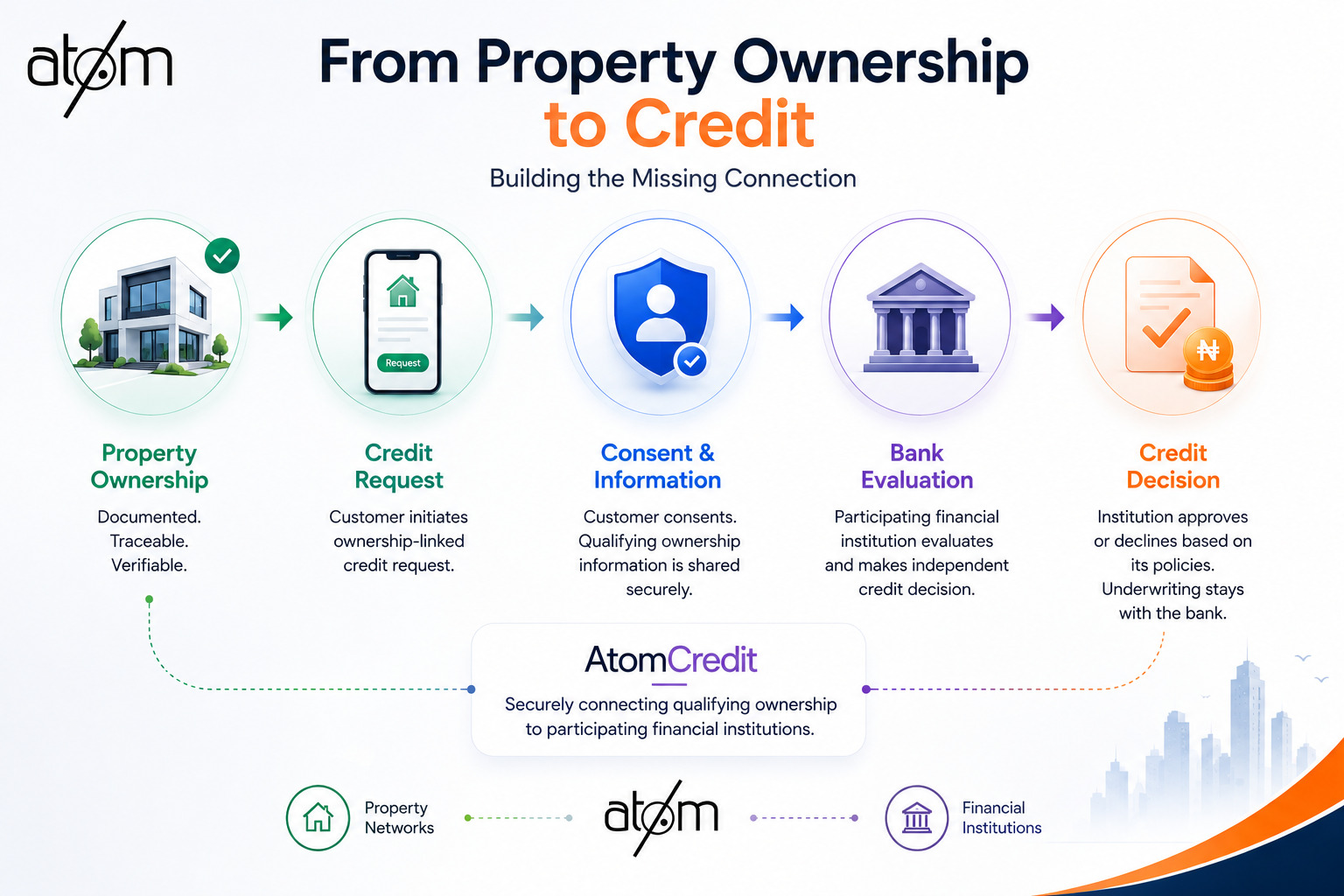
Asset‑linked credit is best understood as a loop with seven stages. This is the flow AtomCredit is built around.
1. Ownership. It starts with a verified record. A customer holds qualifying economic ownership in an asset, recorded on a participating network: documentation checked, value assessed, history traceable. Ownership built progressively, one payment at a time, counts too, because every step is on the record.
2. Credit request. The customer asks for financing linked to that ownership. The request travels with structure: what is owned, what it is worth, and what stake the customer holds.
3. Consent. Nothing moves without the customer's permission. Relevant ownership and trust information is shared with a participating financial institution only with consent. The customer's data remains theirs.
4. Underwriting. The institution evaluates the request independently. It weighs the ownership information alongside everything else it normally considers, then decides eligibility, amount, pricing, and terms. This step belongs entirely to the lender. Infrastructure can make an asset visible; it cannot and should not make the credit decision.
5. Encumbrance. If the institution approves, the qualifying ownership is encumbered: formally recorded as security against the credit. This protects everyone. The lender knows the asset backs the loan. The system knows the same stake cannot quietly secure two loans at once. The customer knows exactly what is pledged and what is free.
6. Credit and repayment. Funds are disbursed and repayment runs on the institution's terms, like any other loan. The difference is what stands behind it.
7. Release. When the loan is repaid, the encumbrance is lifted and the record updated. The customer's ownership returns to full standing, now with a repayment history attached to it. The loop closes, and the asset is ready to work again.
Who does what
A clean division of labour makes this system trustworthy.
The customer owns the asset and controls consent. The network maintains the verified ownership record under common trust standards, supported by qualified independent professionals such as lawyers, surveyors, and valuers. The financial institution evaluates, decides, prices, lends, and collects. The infrastructure, our layer, connects them: making qualifying ownership visible, traceable, verifiable, and connectable.
One principle anchors it all: the bank remains the bank. Asset‑linked credit does not replace underwriting judgment. It gives that judgment better information to work with.
And one honest caveat belongs in every explanation of this model: a verified asset is not a guaranteed loan. No infrastructure can promise that a particular asset qualifies for financing or that an institution will approve a request. What good infrastructure does is remove the reason most requests never got a fair evaluation in the first place.
Does it work in practice?
The model is already running. On NairaPacket, AtomAfrica's owned distribution network and the first implementation of this approach, customers build property ownership progressively with verified digital records. Against more than ₦30 million in ownership facilitated, over ₦5 million in ownership‑backed liquidity has been approved, with zero recorded defaults to date.
Early numbers, honestly small. But they demonstrate the loop end to end: ownership recorded, credit evaluated, funds released, repayments made, encumbrances lifted. The machinery works. The task now is scale.
Why this matters beyond one loan
Every completed loop changes something. The borrower gains capital without selling the asset, plus a repayment record that strengthens the next application. The lender gains a new, better‑secured lending market. The developer gains customers whose ownership carries real financial utility, which makes ownership itself more attractive to build.
Multiply that across thousands of verified assets and participating institutions, and something larger comes into view: a financial system that can finally see what people own, and an ownership economy that can finally access what finance offers.
Africa built the rails for moving money. Asset‑linked credit is what becomes possible once those rails connect to what people own.
AtomAfrica builds the infrastructure connecting financial institutions to economic ownership: AtomBank, AtomOwn, and AtomCredit, proven through NairaPacket. To learn more or partner with us, visit atomafrica.tech.